Guidance Automation BriNgBot Selects MityDSP-L138F

Guidance Automation (www.guidanceautomation.com) of Leicester, England, has recently completed the development of a new GuidanceAutomationautonomous guided vehicle anticipated to improve efficiency and cut costs in warehouses across the globe. The BriNgBot was developed using a Critical Link System on Module (SOM), which enabled Guidance Automation to reduce development costs and time to market. The company plans to introduce the product at multiple exhibitions this summer.

BriNgBot was designed to be a low-price point option that performs as well as or better than more expensive competitors, while omitting vehicle bulk that drives up cost. Industries involved in warehousing and internet sales will appreciate having this cost-effective auto-picking option that promises to overhaul warehouse productivity. The vehicle receives messages via Wi-Fi and uses an advanced camera system to read bar codes on warehouse floors, allowing it to accurately navigate to and retrieve items completely on its own.

“Our goal was to produce a low-cost vehicle, a less expensive but highly effective product with dramatically improved capability and performance compared to currently available alternative systems,” explained Tina Shaw, Guidance Automation’s Director of Marketing. “We most certainly achieved that and are looking forward to sharing the outcome with the world. Critical Link played an important role in our success.”

In developing BriNgBot, Guidance Automation selected Critical Link’s MityDSP-L138F, initiating their design with an off-the-shelf development kit that allowed the team to work on crucial project phases earlier than they would otherwise be able.

“We had a number of products in development over the last two years,” said Simon Edwards, Embedded Hardware and Software Engineer. “We wanted to ensure the module had capabilities for all the products we were working on. Critical Link’s SOM had everything we were looking for in an easy development environment. Because of that, we were up and running very quickly.”

The OMAP-L138 family of SOMs gives system designers the flexibility to address a wide range of requirements. They include the most advanced technology from Texas Instruments’ OMAP family of single and multi-core processors tightly integrated with the new Spartan-6 FPGA from Xilinx. All of the modules in this family are pin-for-pin compatible and available either with or without the on-board FPGA. This allows developers tremendous control throughout a product’s life and is useful for teams developing product families that need various levels of processing abilities.

“Using a Critical Link SOM saved us time, but it also allowed us to think about our own added value,” explained Dr. David Barnett, Chief Technical Officer at Guidance Automation. “We could save our engineering talent for the bits we are really good at and let the module take care of the electrical engineering.”

That engineering talent is apparent when watching BriNgBot in action. “Guidance Automation managed to develop a product for which any company with a warehouse will be grateful,” remarked Tom Catalino, Critical Link Vice President. “This vehicle performs the necessary communication, reading, navigation, and operating functions at a cutting-edge level. BriNgBot is a great value and a smart choice.”

Guidance Automation insiders say BriNgBot could be available for order as early as the summer, thanks in part to MityDSP-L138F and Critical Link’s exceptional customer service. Interested parties can also visit Guidance Automation’s website at www.guidanceautomation.com.

For complete details on Critical Link’s OMAP-L138 family of SOMs, visit https://www.criticallink.com/product/l138family/.

Read the full case study


About Critical Link

Syracuse, N.Y.-based Critical Link (www.criticallink.com) is an embedded systems engineering firm, offering a broad range of highly customizable, small form factor SOMs and development kits for highly integrated, embedded systems for medical, scientific, and industrial applications. Critical Link’s end-to-end product engineering offerings include design, development, and production services. Critical Link is a Platinum Member of the Texas Instruments Design Network. Critical Link is ISO 9001:2008 and ISO 14001 Registered by SRI Quality System Registrar.

More on ARM and the Internet of Things

In September, I had a post on ARM and the Internet of Things (IoT). We’re interested in ARM, of course, because we have a number of ARM-based SOMs – the MitySOM-5CSx, the MitySOM-335x, and the MityDSP-L138 – and because, over time, I believe that the IoT will become synonymous with computing, and we’ll no longer talk about IoT at all!

We didn’t attend last week’s ARM TechCon, so I didn’t get to hear Mike Muller, ARM’s CTO give his keynote. One of his focuses was on the security issue, which has been an ongoing issue for IoT  apps – especially the consumer-oriented ones that have been leaving people’s homes and wallets vulnerable.

At the conference, ARM:

“… announced a Web service that uses a smartphone to authenticate and provision a consumer IoT device securely. Next year, ARM plans to add more Web services for provisioning and managing IoT devices.

One goal of the new services is “to make IoT look like the mobile Web not embedded control” for millions of app developers because “they are the people who will drive most of the innovation in the future,” Muller said.

Last year, ARM launched Mbed, its own operating system for IoT nodes. “We see a huge hole in the ecosystem of [OSes] working with all the standards and security — it’s a multiyear effort so these devices get easy to build,” said Christian Flautner, manager of ARM’s IoT initiative in a press Q&A after the keynote.” (Source: EE Times)

We’re not on the consumer-based end of the app spectrum, but no one’s going to argue that better IoT security isn’t going to be a good thing.

Muller had other things to say, including some discussion of ARM-based servers. ARM believes that, by 2020, they’ll have 25% of the server processor market, as well as 45% of the processors embedded in communications gear by that date. This latter dovetails with the growing interest we’re seeing in ARM processors from our clients. We still have customers using DSP, but the future looks more ARM-based.


TI Announces Sitara AM57x

Don’t know if you caught TI’s announcement last week, but there’s a new kid in town in their Sitara processor family.

“Sitara AM57x processors are designed for a broad range of embedded and industrial applications through their unique heterogeneous architecture including ARM Cortex -A15 cores for high-performance processing and running a high-level operating system (HLOS). Additionally, AM57x processors integrate TI’s C66x digital signal processors (DSPs) for analytics and real-time computation, programmable real-time units (PRU) and ARM Cortex-M4 cores for control functions, and video and graphic accelerators for advanced user interfaces and multimedia applications.” (Source: TI news release)

TI believes that the AM57x will be a game changer for the embedded market. Time will tell if this turns out to be the case, but this SoC is certainly going to pack a performance punch. As we continue to see the industrial Internet of Things (IoT) evolve, there will certainly be demand for the advanced SoC offers. Beyond the industrial IoT, the applications that the AM57x is aimed at include factory automation, machine vision, human machine interface, robotics, and medical imaging.

Along with the Soc, TI is bringing out a new Processor SDK which will work across TI’s Sitara and DSP portfolios.

We’ve worked with the Sitara family before. Our MitySOM-335x is based on the Sitarta AM335x ARM Cortex-A8-based processor, and the MitySOM-1808 features the Sitara AM1808 ARM-based CPU.

The AM57x is generating plenty of interest, and some of our clients have been talking to us about it. We have no immediate plans for building a SoM based on the AM57x, but we’re keeping an eye on it, and an ear to the ground for opportunities.

ARM and the Internet of Things

From Critical Link’s point of view, one of the most exciting things about the Internet of Things (IoT) is that it’s pretty much synonymous with embedded technology. And from Critical Link’s point of view, we’re always interested in reading about ARM technology, as well, as ARM is incorporated in a number of our System on Modules. Thus I was doubly happy to come across a couple of articles by David Blaza on the topic of ARM and the IoT, which were published on the ARM Connected Community.

In the first, David addressed security in the IoT. As most are aware, when it comes to the IoT, security is something of the elephant in the room. Many applications, especially on the consumer side, are being rushed to market without the type of robust security solution in place that industrial applications get. And, of course, since they’re connected to the Internet, any embedded apps that are part of the IoT have inherent vulnerabilities that an app that operates within the walls don’t have. A recent ARM trend will help shore up IoT security.

“…the trend is many new ARM based multicore boards coming to market that for the first time can run multiple operating systems simultaneously.  By running multiple operating systems the data coming from say real time sensors can be completely isolated from intrusion and be encrypted and sent to the cloud securely.  At the same time another operating system (like Android or Ubuntu) can manage the user interface and network connections. ” (Source: ARM Connected Community – April 27, 2015)

David had more to say about ARM’s multiple OS capabilities in a follow on post.

“Any good embedded software developer has to think about the classic tradeoff of system performance versus reliability/up time which if you are running a single OS it can be challenging and limiting.  With ARM multicore boards being available for under $100 now SMP and AMP are within reach of every embedded developer.  The other trend that comes into play here is that increasingly embedded systems (and their IoT progeny) need graphical user interfaces (GUI) and access to multiple communications networks.  So in many embedded designs running separate operating systems to handle different system functions solves many of the classic tradeoff problems and now it’s never been easier.” (Source: ARM Connected Community – May 1, 2015)

In this post, David gives a shout-out to Express Logic, and their ThreadX RTOS, which supports our MityDSP-L138 board, a SoM combining a TI C674x DSP, an ARM9 processor, and an optional FPGA.

Critical Link’s first multicore product features the dual ARM Cortex-A9 Altera Cyclone V SoC. A number of our customers have inquired about AMP for just the reasons David points out in his follow-up post.the OS that excels at data acquisition and processing isn’t necessarily the best choice for supporting external user and system interfaces.  However there are challenges that make AMP difficult to implement in many multicore architectures, particularly around inter-processor communication, cache and shared resource management. We have not yet worked with an AMP solution on our Cyclone V SoC SOM, but I’m sure we will soon!

MitySOM-5CSx Gives Industry Leader a New Competitive Edge

Critical Link is pleased to announce the exceptional results being achieved by the first wave of customers getting to production using its MitySOMTM-5CSx System on Modules (SOMs). Companies using these SOMs are realizing a competitive advantage through significant reduction of the time and cost involved in bringing new electronic products to market.

SaabSensis_216x185Saab Sensis Corporation, a world leader in surveillance and information technology for the aviation industry, recently partnered with Critical Link to develop the newest generation of their ground based ATM sensor. This state-of-the-art product receives the signals transmitted by aircraft for the purpose of locating them in space. Saab Sensis used MitySOM-5CSx to jumpstart and accelerate development.

“We’d developed our own boards before,” said Chris Schierer, Saab Sensis Senior Staff Systems Engineer and Lead Engineer for the ground based ATM sensor. “It wasn’t a question of capability. It was a question of where we wanted to focus our resources. When it came down to it, we wanted our engineers to focus on developing our own industry-specific intellectual property – the things that would make us more profitable and competitive.”

Saab Sensis was first attracted to the 5CSx module because it incorporates Altera’s Cyclone V SX processor. Engineers were excited to discover the Critical Link module offered an embedded ARM processor in an Altera FPGA, all in the module that offers the RAM, interfaces, and other features as well as the support they desired. The Cyclone® V System-on-a-Chip (SoC) is a powerful, fully programmable hardware and software building block that significantly improves system performance via the high-bandwidth between the single or dual ARM® Cortex™-A9 processor and the Cyclone® V FPGA fabric.

Chris Gourrier, Marketing Manager at Altera Corporation adds, “Using an SoC SOM such as the MitySOM-5CSx affords the designer access to this powerful FPGA SoC architecture, including productivity-enhancing features such as Altera’s exclusive FPGA-adaptive SoC debugging, while providing the opportunity for shorter time to market, lower development costs, reduced risks, and expert support from an experienced Altera design partner, Critical Link.”

Each part in the MitySOM-5CSx family is pin-for-pin compatible, allowing development teams the flexibility to quickly and cost-effectively meet customers’ unique requirements. The products are highly configurable, offering a wide range of technical features in a small form factor. Critical Link designed the SOM family with rigorous industrial, medical, and defense applications in mind, targeting long-term production with 10-15-year availability from initial release.

As with many Critical Link customers, the key reason Saab Sensis sought out a SOM was to make development of the ground based ATM sensor smoother and faster. MitySOM-5CSx exceeded expectations. “When our custom boards arrived, we were able to plug in the SOM, put our code in, and we were up and running in 24 hours,” recalled Schierer. “That is miraculous. There were people walking around the building with their jaws hanging down, saying, ‘I can’t believe we’re up and running on the first day.’” The MitySOM-5CSx family offers a wide range of processing densities, speed grades, and temperature options at competitive costs. Standard variants and development kits are available today from numerous major distributors. If a standard variant does not meet your specification, contact Critical Link to discuss developing a custom solution.

For complete details on the MitySOM-5CSx family, visit https://www.criticallink.com/product/mitysom-5csx/.

>>Read the full Saab Sensis case study: https://www.criticallink.com/customers/success-stories/.

About Critical Link

Syracuse, N.Y.-based Critical Link (www.criticallink.com) is an embedded systems engineering firm, offering a broad range of highly customizable, small form factor SOMs and development kits for highly integrated, embedded systems for medical, scientific, and industrial applications. Critical Link’s end-to-end product engineering offerings include design, development, and production services. Critical Link is a member of the Altera Design Services Network and a certified member of the Arrow Consulting Engineering Services (ACES) network. Critical Link is ISO 9001:2008 and ISO 14001 Registered by SRI Quality System Registrar.

Big news on the semi-conductor front

There’s been so much change in the semiconductor world these days, it’s hard to keep up with it all. Last week, it was the Avago-Broadcom deal. This week, with the agreement that Intel will acquire Altera, the wheelings and dealings are coming a bit closer to home.

Altera has been a partner of ours for the past two years. Our MitySOM-5CSX features the Altera Cyclone V SOC, which combines FPGA logic and a dual-core ARM Cortex-A9 processor subsystem.

Obviously, with this acquisition, we’re talking about a far different order of magnitude than our partnership with Altera, but Intel is interested in Altera for the same reasons that we are. One of them is FPGA.

“Intel is known for general-purpose microprocessor chips that can be programmed to perform a near-infinite variety of computing tasks. Meanwhile, some kinds of operations-such as converting a video from one format into another or encrypting data so unauthorized people can’t read it-can be executed more quickly using circuits custom-tailored for the task.

“But the cost of making chips from scratch has risen steadily over the years, and fewer companies now do so. Altera, along with rival Xilinx Inc., popularized a middle path with chips called field-programmable gate arrays, or FPGAs, that are configured by customers to handle certain kinds of jobs after the chips leave the factory.

“Altera’s programmable chip technology is widely viewed as a way for Intel to protect its stronghold in selling chips for servers, a market that generated more than half of Intel’s operating profit in the March-ended quarter. Companies have been using FPGAs alongside Intel’s Xeon chips to help speed up their servers, and some analysts believe that Intel needs to have an internal source of the technology to respond to the trend.” (Source: Wall Street Journal)

Another reason is ARM, which has been making inroads into the data center. The good news for Critical Link is that Intel will continue to support Altera’s ARM technology products.

I think that this acquisition will be all for the good. The possibilities for other devices that will be developed as a result of Intel’s acquiring Altera should be very, very interesting. In the embedded space we’re particularly interested in seeing what innovation the Altera acquisition will bring to the Intel Atom and Quark product lines.


————————————————————————————————————————–


(If you’re interested, you can find the press release here.)

Advanced processing for ADAS

Like so many things in life, cars are getting smarter. And all those smarts are requiring more and more computing power. Even not-so-smart cars run on embedded systems and complex electronics. As David Blaza pointed out in a recent post on Embedded, the 2011 Chevy Volt had 10 million lines of code in it.

For really smart cars, ARM has predicted that, by 2024, vehicles deploying Advanced Driver Assistance Systems (ADAS) will need a minimum of 100x more computing performance than 2016 models.

“Today, premium cars have more than 100 processors on board utilizing tens of millions of lines of code. To meet future ADAS demands, ARM expects processor performance compared to 2016 vehicles to increase 20x by 2018, 40-50x by 2020 and 100x by 2024. Meeting this ambition will require deeper functional safety support and higher performance, energy-efficient SoCs.” (Source: ARM)

To do their part, “ARM is licensing functional safety support across its Cortex-A, Cortex-R and Cortex-M processor families.”

As cars get smarter – more and more reliant on electronics and less and less reliant on the driver – functional safety becomes more and more important. Yes, a lot of what’s going into smart cars is on the entertainment-side, but that’s relatively minor compared to ADAS. It’s one thing when your music system fails an you can’t access your playlist. It’s quite another when the actual driving is systems-dependent. Malfunctioning systems are no longer an annoyance; they’re a clear danger.

Our partner, TI is one of the companies jumping on board, and will be licensing the latest ARM Cortex-A72 processor. (We don’t – at least for now – play in this space. But in case you’re wondering, Critical Link does have some Cortex-based SOMs. The MitySOM-335x, which is Cortex-A8, and the MitySOM-5CSX, which is Cortex-A9.)

Anyway, that 100x increase in compute performance required in less than 10 years caught my eye.

New Embedded Vision Cameras on Display at Photonics West 2015

MityCAM_RGBCritical Link plans to demonstrate three of its newest embedded vision solutions at Photonics West, February 10-12. The company’s MityCAM® vision and imaging cameras combine the processing technology in Critical Link’s Cyclone V SoC-based System on Module with high performance imaging sensors from top manufacturers, including Fairchild Imaging and CMOSIS.

The MityCAM’s integrated dual core Cortex-A9 ARM + FPGA fabric allow for on-board image processing, a key capability when implementing advanced algorithms or overcoming data storage and streaming challenges. Cameras feature an array of I/O options and come in multiple production-ready configurations, including fully-enclosed cameras, complete 3-board sets, and partial board sets for customers who elect to design their own sensor or I/O boards.

Multiple MityCAM models will be demonstrated on the exhibition floor at The Moscone Center in San Francisco, CA. The MityCAM-B2521F, with a 5.5MP ultra-low noise sCMOS sensor from Fairchild Imaging, will be conducting an extreme low-light demo capturing images at .01 lux, an environment equivalent to a moonless clear night.

Other demonstrations will include the MityCAM-B1910F and MityCAM-C8000, showing standard image processing capabilities in both rolling & global shutter modes. The MityCAM-B1910F includes a 2.1MP low noise, high dynamic range sCMOS sensor from Fairchild Imaging. The MityCAM-C8000 is based on a CMOSIS 8MP high-speed, global shutter CMOS sensor.

PW-logo_263x38Visit Critical Link at Photonics West booth #2708 to view these demos and to see how the MityCAM platform can be tailored to meet your project requirements. You can also learn about our CCD-based camera solutions, developed for high-throughput scientific imaging applications.


About Critical Link

Syracuse, N.Y.-based Critical Link (www.criticallink.com) is an embedded systems engineering firm, offering a broad range of customizable imaging and vision solutions for highly integrated, embedded systems for medical, scientific, surveillance, and industrial applications. Critical Link’s end-to-end product engineering offerings include design, development, and production services. Critical Link is a member of the Altera Design Services Network, a Platinum Partner of the TI Design Network, and a certified member of the Arrow Consulting Engineering Services (ACES) network. Critical Link is ISO 9001:2008 Registered by SRI Quality System Registrar.
MitySOM-5CSx Family Expands for Broader Market Appeal


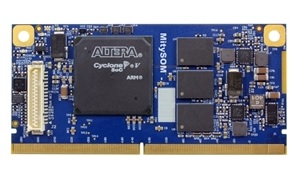
Critical Link today announced the expansion of its MitySOM®-5CSx family of System on Modules (SOMs). The newest addition to the family, the MitySOM-5CSE, is projected to have broader market appeal given its enhanced flexibility and lower price point than the original MitySOM-5CSX.

“Not everyone needs technology as powerful as the original MitySOM-5CSX,” explained Tom Catalino, Critical Link’s Vice President. “Our goal is to offer products that are just right for the customer’s application. The original SOM is a good fit for demanding requirements in areas such as alternative energy, medical, aerospace, and defense. This new MitySOM-5CSE leverages the advanced technology of Altera’s Cyclone V SoC in a smaller, lower power configuration featuring a single Cortex-A9 ARM core and 25K Logic Elements of FPGA fabric. It offers more I/O than the original parts, resulting in greater flexibility and an overall spec better suited for a broader spectrum of applications.”

All products in the MitySOM-5CSx family are pin-for-pin compatible, allowing development teams room to grow and the flexibility to quickly and cost-effectively meet customers’ ever-changing needs. The products are also highly configurable, with numerous combinations of technical features available. Additional parts will be introduced in this family in 2015 to fill out the range of processing density, speed grades, and temperature options.

“As a member of the Altera Design Services Network, Critical Link provides the best solutions to fit customers’ needs utilizing Altera’s industry-leading FPGA and SoC solutions.  With the MitySOM, customers can reduce system power, cost, and board size while taking advantage of extremely high bandwidth between the FPGA and ARM® Cortex™-A9 processor in the Cyclone® V SoC,” said Chris Gourrier, Marketing Manager at Altera Corporation.  “The MitySOM provides customers all the powerful benefits of the Altera Cyclone® V SoC along with a much faster path to market.”

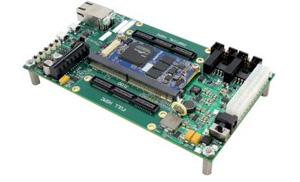
MityDSP-5CSX-Dev-KitNew MitySOM-5CSE modules and development kits are available today, and anticipated to be in stock at Arrow this month. Standard product variants will be available in any quantity, custom variants are also available with minimum orders. “Design teams can come to us with specifications for their perfect SOM,” said Catalino. “Critical Link is ready and able to put these custom solutions into production immediately.”

For more information about the MitySOM-5CSx family and currently available models, visit https://www.criticallink.com/product/mitysom-5csx/.

About Critical Link

Syracuse, N.Y.-based Critical Link (www.criticallink.com) is an embedded systems engineering firm, offering a broad range of highly customizable, small form factor SOMs and development kits for highly integrated, embedded systems for medical, scientific, and industrial applications. Critical Link’s end-to-end product engineering offerings include design, development, and production services. Critical Link is a member of the Altera Design Services Network and a certified member of the Arrow Consulting Engineering Services (ACES) network. Critical Link is ISO 9001:2008 Registered by SRI Quality System Registrar.
8MP Camera With On-Board Processing Unveiled at VISION Trade Fair


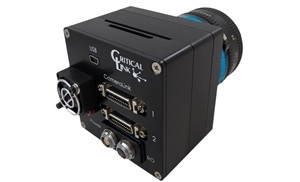
Critical Link unveiled the newest addition to its MityCAM® family at VISION, the leading world trade fair for machine vision, earlier this month in Stuttgart, Germany. The MityCAM-C8000 generated excitement among those who viewed demonstrations, particularly for its on-board processing and windowing capabilities.

“We’re pleased the MityCAM-C8000 was so well-received at VISION,” said Omar Rahim, Critical Link’s co-founder and Vice President of Imaging Solutions. “Our team has been working diligently to produce a camera with truly exceptional windowing abilities, running speeds, and image quality. We knew we had something special, but it is a meaningful success for us to have the industry embrace the technology so enthusiastically.”

MityCAM-C8000 offers an 8-megapixel (MP) resolution and incorporates a specialized half-sensor that allows the user to access multiple-window functions and process information at top speeds. The sensor was developed by CMOSIS, a leading supplier of advanced image sensors.

The MityCAM-C8000 is just one product in Critical Link’s family of highly configurable imaging and vision solutions. The platform is designed to be customizable with a variety of high-MityCAM_RGBperformance sensors, SoC processors featuring tightly integrated ARM and FPGA fabric, and multiple I/O options. MityCAM products deliver robust on-board processing capabilities that make them ideal for scientific imaging and vision applications involving high-throughput and advanced image processing. Customers benefit from the platform’s flexibility, with each building block tailorable to suit the application. Production-ready configurations include full cameras, complete 3-board sets, and partial board sets for customers who elect to design their own sensor or I/O boards.

Critical Link plans to continue the expansion of the MityCAM platform to meet the diverse needs of many industries and applications.

For more information about the MityCAM platform and currently available models, visit https://www.criticallink.com/products/scientific-cameras/mitycam-platform/.

About Critical Link

Syracuse, N.Y.-based Critical Link (www.criticallink.com) is an embedded systems engineering firm, offering a broad range of customizable imaging and vision solutions for highly integrated, embedded systems for medical, scientific, surveillance, and industrial applications. Critical Link’s end-to-end product engineering offerings include design, development, and production services. Critical Link is a member of the Altera Design Services Network, a Platinum Partner of the TI Design Network, and a certified member of the Arrow Consulting Engineering Services (ACES) network. Critical Link is ISO 9001:2008 Registered by SRI Quality System Registrar.