Robotic technology comes to the world of furniture

OriDating back to my graduate school days – now a few decades in the rear-view mirror – I’ve had a long-running interest in robotics, and I’m always on the lookout for new applications.  One that I came across recently is from a spin-out from the MIT Media Lab. The Lab is a real innovation hub, and its current research groups focus on project “that range from digital approaches treating neurological disorders, to a stackable, electric car for sustainable cities, to advanced imaging technologies that can ‘see around a corner.’”

The Media Lab spin-out that’s been getting some press lately is Orisystems, which describes itself as “the brawn and brain of the furniture and architecture of the future.” The systems that Ori designs – and the name, by the way, is taken from origami, the Japanese paper-folding art –  are built for micro-living. Micro-living has a number of different faces. It’s the “tiny house” movement, where mostly-young folks build mostly-portable small houses (some as small as 200 square feet) and either haul them around with them, or plunk them in someone’s back yard. There are a couple of TV shows devoted to this movement, and some of what the builders do to maximize the use of space is really clever.

Another face of micro-living is the development of apartment buildings that specialize in very small units, which are largely going up in large cities where housing costs are prohibitive. From what I’ve seen, these small apartments are designed for the young and tech-savvy. And this is where Ori comes in.

“Running on modular and scalable mechatronics, Ori units seamlessly glide with the light push of a button. The on-device interface uses motion sensors to light up, with pre-settings for the different possible configurations and the ability to connect to other smart devices. Ori is the brawn and the brain of the furniture and architecture of the future.” (Source: Orisystems, where you’ll also find a couple of videos that illustrate how this all works.)

While I’ve seen it pop up in a couple of other places since, I first read about Ori in Wired.

“The first rollout is essentially a big wall of shelves with a pop-out desk, a closet, and a trundle-style bed tucked underneath. Sensor-rigged actuators are hard-wired to a control panel that attaches to the Ori wall, like a thermostat or an app. With the push of a button—or, with future versions of the software, at the sound of a voice or wave of a hand—pieces of Ori furniture will slide up, down, or over, reconfiguring spaces in mere moments… A bed can disappear, to make room for a work desk. A wall can come down, to create private spaces in an otherwise open studio apartment. A 350-square-foot apartment will, ideally, function more like a 600-square-foot one.” (Source: Wired)

As always, I’d be interested in learning the details on the technology used, but I haven’t been able to dig anything up.

In any case, you won’t be able to buy these systems off-the-shelf at IKEA. Not yet, anyway. Ori is working with developers to incorporate their systems in new buildings. Not that I’ll be in the market for a micro-apartment. We’re not quite empty-nesters yet. And then there are the dogs. And all the stuff you accumulate as life goes on. But this is definitely an interesting concept and some cool technology.


The Internet of Tomatoes

As we’re nearing that great time of year when local farm stands (and neighbors’ backyard gardens) have local tomatoes, I couldn’t resist what appears to be an advertorial by Analog Devices (a.k.a. ADI) that appeared in a recent Technology Review. I mean, how could I pass up a piece entitled IoT: The Internet of Tomatoes?

ADI is headquartered in Massachusetts, and the piece starts out with a critique of New England native tomatoes. I went to grad school in Massachusetts, and I don’t recall the native tomatoes being awful, but I’ll take ADI’s word for New England’s tomatoes being “comparatively tasteless” fare that generally get turned into ketchup rather than get served up in a nice Caprese sandwich. Anyway, ADI partnered with some local farmers on their Internet of Tomatoes project.aditomatoesinfographic2

“This precision agriculture experiment uses technologies such as micro-electromechanical systems (MEMS) and sensors to figure out whether environmental monitoring could improve flavor.”

It looks at two aspects of tomato-cultivation: temperature and “growing-degree days.” Their launch was in January. Having been in Massachusetts in January (not to mention having spent my life in Upstate New York), I can promise you that there’s not a lot of farming going on. But January 2015 – that was the year New England really got clobbered with a ton of snow – would have made a good test case for technology survival. Working on a farm that lacked both usable power and Internet access, they decided on wireless (Bluetooth) sensors that communicate with handhelds (iOS or Droid). Data being communicated includes average daily max and min temperatures that are specific to each farm. The system is also incorporating info from a pest-management application, so farmers can keep tabs on beetles. Overall, the goal is to figure out best to cultivate tomatoes, and the best time to harvest them.

ADI is also taking a look at the chemistry of tomatoes. In doing so they’ve figured out why New England tomatoes aren’t as tasty as those found elsewhere:

“They don’t have high fructose, glucose, or salt content—which is why when most people grab a New England–grown tomato, they also grab a salt shaker…From an aesthetic perspective, the New England tomatoes look like any other. But on the inside, the chemistry doesn’t match up, according to ADI’s analysis of thousands of tomatoes.”

ADI is also experimenting with a non-invasive way to test tomato chemistry, not just for taste but for nutritional value. They’re working on an optical system that uses nearfield infrared technology. “Optical technology will [also] measure the soil, leaf, and stem lengths and their stress levels.”

Overall, it looks like an excellent use case for the IoT.

But about those salt shakers: I was of the belief that part of the pleasure of eating a native, Upstate New York tomato is having the tomato in one hand and the salt shaker in the other. Given this, I’m guessing that ADI’s Internet of Tomatoes will find a home in my neck of the woods, and not just in New England.


UL and the IoT

We’re all familiar with Underwriters Lab, and we’re used to seeing the UL symbol on the cord tag of our electrical appliances.  But things electrical – which were just being introduced when UL was founded in 1894 – have given way to things electronic.  And (depending on who you’re listening to) sooner or later, everything electronic (including all those UL-labeled appliances) will end up as part of the Internet of Things (IoT).

Earlier in the year, the UL published a cybersecurity standard “for the testing and certification of connection devices.” UL 2900 aims to address what has been one of the more significant barriers to wider spread IoT adoption: security.UL

While some have welcomed UL jumping in with their Cyber Assurance Program – they believe that it’s useful to have a third party certification available in this arena –  there’s concern that there are already so many security requirements established by vertical industry segment, that there’s really no room to adopt a truly common set of standards.

EE Times last week published in interesting article on this, including a Q&A session they had with UL, and I thought it would be interesting to pull out some of the highlights. (All material in quotes in this post comes also comes from the EE Times article, which can be found here.)

  • UL has been in the security space for more than two deca
    des, and have been dealing with cybersecurity for the past decade, so they have some experience and credibility in the area. (UL was the organization that developed FIPS 140 (The Federal Information Processing Standards used by the US Government.
  • They decided to create their Cyber Assurance Program (CAP) once the saw the security problems were emerging in areas beyond traditional IT. They saw that “risks are spreading out into HVAC, automotive, lighting, factory automation and medical fields” – i.e., the IoT world. CAP was in response to this, and – more directly – to a request from the Department of Homeland Security to “develop testable security criteria, through which UL can test, validate, authenticate and certify networked devices.”
  • This is the testing they do: “Software used within products – ranging from chips to components and systems. We look at existing vulnerabilities, defects and patches known to third-party vendors. We test to discover coding errors and security loopholes in software, operating systems or networks. We see how a system accesses remote devices and do software updates. We offer structured penetration testing regimen, and see if we can plug those holes. We define flaws and weaknesses and provide scientific repeatable and reproducible testing criteria.”
  • Of interest: they’ll test automotive components, but not vehicles themselves. Too much of the data they’ need belongs to the automotive industry, and is not available through NIST, which is the database they use for information on vulnerabilities.

Those are some of the highlights. If you’re building an IoT application (other than a connected vehicle) and you think UL certification might be useful, check out the full article, or take a look at UL.com.

Energy efficiency for commercial buildings

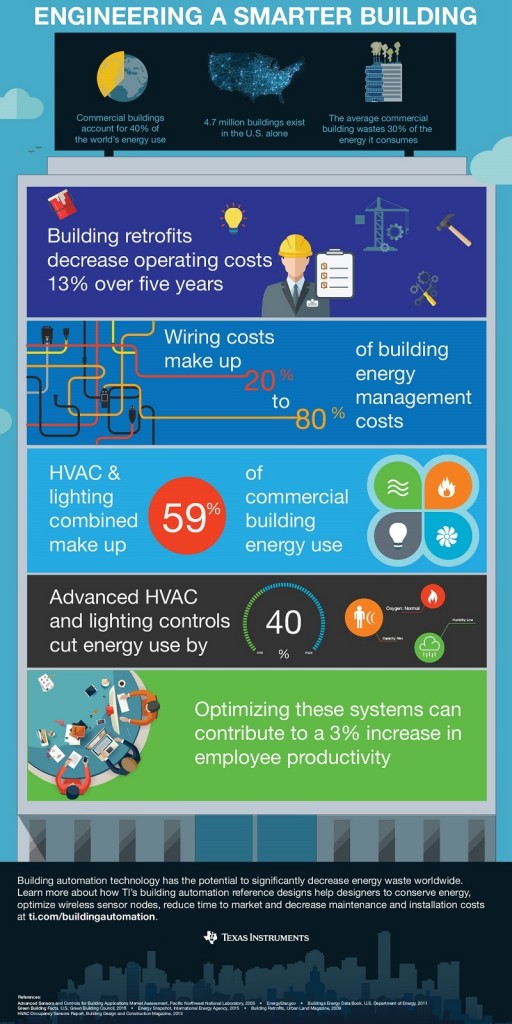
I was catching up on my blog reading, when I came across an interesting post (and infographic) from TI, a long-standing technology partner of Critical Link. In the post, from this past February, Adam Yager wrote about the trend toward using connected sensors to create energy efficiency in commercial buildings. Coming on the heels of last week’s post on pushback on the Internet of Things (IoT), especially on the consumer side, it was pretty apt to see something written about an area where the IoT (and wireless sensor networks) are being adopted – and are actually producing results that justify the investment.

Let’s take a look at the infographic that Adam included in his post. The first interesting details are that commercial buildings account for 40% of global energy consumption, and – shockingly – the average commercial building wastes 30% of the energy it uses. Given that, when combined, HVAC and lighting make up 59% of commercial building energy consumption, it certainly makes sense to give the grid a break and try becoming more energy efficient.buildingautomation.jpg-1230x0

The payback for investing in energy efficiency is significant: decreased operating costs (energy use can be lowered by 40%) and increased employee productivity. (Okay. I’m a bit skeptical about that increase in productivity, but if we just leave it at the provable metric of lower costs, it’s still worth investing.)

Here’s how sensors are used to increase energy efficiency:

“In HVAC systems, intelligent monitoring and control can be achieved by adding stand-alone environmental sensors, which will take accurate temperature and humidity readings for each zone or room throughout a building… Rather than having one central temperature-monitoring device, adding multiple sensors throughout a building gives you more options to control heating and cooling zones based on occupancy or time of day.

“Large commercial buildings can use people-counting systems for demand control ventilation (DCV). DCV adds fresh air based on the amount of people occupying a room, rather than having the HVAC system turn on based on a preset control regardless of the number of occupants present.” (Source: TI blog)

Similarly, for lighting control, connected sensors would also use occupancy detectors, as well as daylight sensors that could harvest energy, to make better use of lighting. (Many of us have experience with this approach being deployed in conference rooms that aren’t in continual use.)

One reason why the IoT has gotten more traction commercially than with a consumer audience – at least in my opinion – is because they are more immediately useful and understandable, and provide real value.  Lowering energy costs by 40% is something we can all appreciate. Being able to check your fridge via smartphone to see if you need eggs (the “storyline” from a new Samsung smart refrigerator ad) is probably not going to get many consumers too excited!


Pushback on the IoT

I guess it was inevitable. After all the hype. After all those forecasts of kabillions of connected devices. After all the cool videos showing smart everythings. There seems to be a bit of a backlash forming around the Internet of Things (IoT).

There’s never been any lack of muttering about IoT vulnerabilities, with tech pundits and analysts pointing out all along that that having all these IoT devices out there, many in the hands and homes of “civilians” (i.e., non-techies), was a security nightmare in the making.  But now those concerns about security have gotten through to the consumers who were supposed to be fueling the growth of IoT. A January Accenture survey, that was cited in a blog post I saw on EE Times, found that security “has moved from being a nagging problem to a top barrier as consumers are now choosing to abandon IoT devices and services over security concerns.”

While security and privacy concerns were keeping nearly half (47%) of the 28,000 respondents from buying into IoT, the top issue (62%) was how expensive IoT devices were. Nearly one-quarter (23%) couldn’t see how IoT devices would be useful to them, while 17% found them too confusing.

Thermostats, like Nest, are pretty much the only IoT-based appliance that people welcome into their home. This makes sense. The application is obvious, and the interface is pretty straightforward. (At least to me: I’ve had one for a few years.) But consumers are apparently just saying no to smart refrigerators and dishwashers. That said, I have recently begun seeing an ad for a new Samsung fridge that you can look into (via your smartphone) to check the contents. I will say that the ad doesn’t make the point very well. A guy’s at the grocery store and calls his wife to ask her whether they need eggs. She’s sitting next to the fridge, but is too involved in whatever it is she’s doing to get up and check. So the fellow whips out his smartphone and sees for himself that they do, indeed, have eggs. I’m no ad man, but wouldn’t it make more sense to have someone check the fridge who didn’t have someone sitting at home who could easily check it for him? Maybe I’m missing something here.

Anyway, in his EE Times post, Pablo Valerio points out that there’s a difference between “smart appliances” (like the fridge you can remotely peer into) and smart functions “such as dedicated sensors that can send an alert when, for example, they need some preventive maintenance or replace a critical component.”

I’m with Pablo here. I believe that consumers will welcome appliances with smart functions into their homes. Why wait for your furnace to conk out on the coldest night of the year, when you can get a call letting you know you need a service call?

I have to confess that I remain interested and intrigued by the IoT, and believe that the Internet of Everything (which is how Cisco has named it) is pretty much the future. But I’m not surprised to see that some of the hype is beginning to die down.

What’s next for newspapers?

We’ve been hearing for years that newspapers and magazines will be dying out, any day now. We want our news in real-time, and we want it in video format. Print? That’s for old timers with time to read and time to wash the newsprint off of their hands. And then there comes some pretty exciting news about the news.

Patrick Soon-Shiong has invested $70.5 million in the Tribune Publishing Company, which – among other papers – owns the LA Times and the Chicago Trib. But he’s not just throwing good money after bad. Soon-Shiong wants to remake the newspaper reading experience. He recently said that:

“…he wants to use “machine vision” technology he’s developed to transform the experience of reading a print newspaper…

For example, a reader could pan a camera across a physical newspaper and the photos could be turned into video. Focus the camera on a photo of basketball star Kevin Durant … “you’d [see him] dunking,” he said.

“You’d be bringing to life whatever you see on the newspaper,” Soon-Shiong said. “Every page, every picture, every commercial is merely a TV channel activated by the picture itself through machine vision recognition.” “(Source: Bloomberg)

Although it’s not the same thing at all, it does kind of remind me of those “live” pictures on the wall in at Hogwarts, Harry Potter’s school. And I do find it pretty cool and pretty exciting. Although it does raise the question of why you wouldn’t just go online to see a video of Kevin Durant to begin with. My other question is whether the demographic that is still reading print media. My understanding is that, while readership has gone down in all age groups, it remains highest among those who are over 65. Will these readers be interested in taking out a camera, focusing it on a picture in their newspaper, and linking to online video? Maybe not. But maybe the intent is to make physical newspaper readership more appealing to “digital natives.”

Even if I’m not sure who, exactly, this use of machine vision technology is for, it’s still very interesting.

Camping gear goes high tech

If you’re thinking that camping gear is still a nylon pup-tent, a damp and lumpy sleeping bag, and a flashlight, well, I guess you’re still living in the twentieth century. Or so I was reminded when I saw an article last week on Bloomberg about some of the very high technology camping products that are out there.

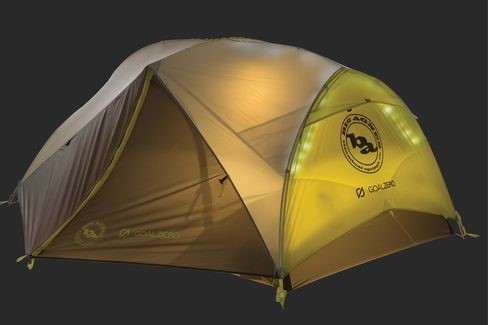
Big Agnes has mtnGLO tents that have LED lights built into the tent body. The one picturedHi-tech tent
here – which costs $650 – also comes with a fan, and solar panels that connect to USB charging stations (because no one really wants to get away from it all when they’re out in the woods; at minimum they want to be able to power up their iPad).

The Rinse Kit – which was funded through a Kickstarter campaign – is a portable shower. Basically, they’ve figured out how to maintain the water pressure from a fill-up via your hose, without requiring a pump or a battery. And it maintains that pressure for a couple of months. It also will keep the water hot for at least a day. The $90 you spend on it will only give you 5 minutes of shower time, so you couldn’t stay off the grid all that long and still be clean. Nonetheless, for those who prefer to camp off the grid, rather than in a campground with showers, this sounds like it might be worth.

Bang and Olufsen has a ruggedized portable speaker: “a scratch- and water-resistant aluminum and polymer body that delivers focused, warm sound in 360 degrees, even when your “venue” has little to offer in the way of acoustics.” And I’m guessing you could use the charging station in your mtnGLO tent to top off the battery. The speaker is $250. (This is all starting to add up, isn’t it?)

You can also spring for a $280 inflatable sleeping pad. The Exped Synmat Hyperlite will keep you comfortably off the ground. Folks have been using sleeping pads for years – really, who wants to sleep on the cold, hard ground? – but this one “takes no more space in your duffle than a small loaf of bread.”

Of course, you don’t want to put just any old sleeping bag on that $280 sleeping pad. The Katabtic Gear Flex is “handmade in Colorado.” Handmade would, I guess, account for the $395 price tag. The design “includes ‘cFLIRontinuous baffles’ that essentially allow you to rearrange the down insulation to suit your needs. A clever ‘foot box,’ for instance, lets you shift more warmth to your toes on nippy nights.” 
From a technical point of view, the most interesting product  – to me, at least – was the FLIR Scout TK night vision monocular. For $599, you’re really going to want to be up and looking around in the dead of night. Unlike some of the other products mentioned in the article, you could actually get the specs on this one from FLIR.

Anyway, with summer upon us, a lot of folks will be heading out to do some camping. And there’s a lot of cool stuff out there, if you really want to gear up.


“The Fantastic Voyage” may be coming true

There’s an old sci-fi movie, from the 60’s, called Fantastic Voyage. The plotline has a scientist defecting to the West, who’s shot in an assassination attempt and needs a blood clot removed from his brain. I can’t remember why they just couldn’t operate on him the old-fashioned way – I guess there wouldn’t have been a movie if they’d been able to – but what they do instead is miniaturize a submarine (and its crew, including a surgeon) and inject it into the scientist to take care of the blood clot.

Science and technology has not as yet advanced to the stage where submarines and surgeons can be micro-sized. But there have been tremendous strides made with robotic surgery and with less invasive surgical methods, and there are new technologies emerging that are very exciting. One of them was discussed in an article I saw the other day on the MIT news site.

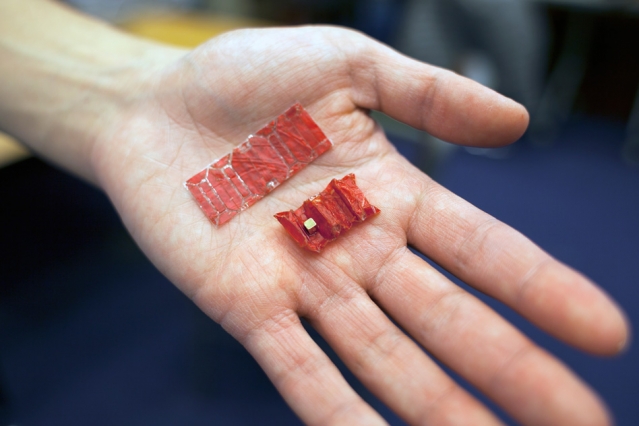
At the recently-held International Conference on Robotics and Automation, researchers showed off, in an experiment involving a simulated esophagus and stomach, a miniature “origami robot that can unfold itself from a swallowed capsule and, steered by external magnetic fields, crawl across the stomach wall to remove a swallowed button battery or patch a wound.”MIT-Microsurgeon-2

The description of the origami robot is very interesting, so take a look at the full article.  They had to make sure that the robot was tiny enough to swallow yet had the force inside to make sure that it unfolded. There’s also a magnet in side that’s controlled externally to get the robot in place. In the button battery experiment, the magnet also picked up the battery.

The choice of the button battery application is a good one.

In the old days, parents worried about their kids swallowing pennies, but those pennies mostly worked their way through the system with no harm done. When swallowed, button batteries – and the article reported that 3,500 incidents of it are reported annually in the U.S. alone – can end up causing burns to the tissue in the stomach and the esophagus, requiring invasive surgery to remove the button and treat the wounds.  With technologies like the origami robot making its fantastic voyage, those surgeries will be a thing of the past.

DSP’s in the news. (Seems like it’s been a while…)

Is it just my imagination, or are there fewer news articles on DSP these days?

At Critical Link, we’re – of course – quite partial to DSP. Many of our clients have deployed System on Modules that contain DSP. And way back in the day (about a decade back in the day), our original SoM, which we then called a customizable CPU platform, was the MityDSP. Since then, we’ve developed a wide range of SoMs, and the market focus has certainly shifted to ARM, but we still have a number of variations on the MityDSP in our product family (including embedded in some of our imaging systems). So I was happy to see good old DSP in the news.

The article I saw a few weeks back was on Cadence Design Systems, which is promoting its approach to neural networks.

“Cadence maintains that neural networks deployed in embedded systems that are built on programmable digital signal processor (DSP)-based SoCs offer advantages in power consumption, performance and time to market compared with networks built on CPUs or combinations of CPUs and GPUs.” (Source: embedded.com)

The reason? DSP-based neural technology – that would be Cadence’s Tensilica Vision, which is designed for vision/deep learning applications – doesn’t run as hot as a graphics processing unit.

 “’Our value add is always going to be in the low-power, high-performance and highly energy efficient product,’ [Pulin] Desai [director of product marketing for Cadence’s Imaging/Vision said. ‘Most of the GPU type of products were developed to do classical 3D image processing and they were developed to do a lot of activities in floating point and to do multiple threads at the same time. At the end of the day they are not power efficient based on a lot of these reasons.’”

Interesting.

Even further back in the day I was exposed to the early days of Neural Networks during some of my course work for my Master’s Degree in Computer Science. Now, the technology may have changed drastically, as it has evolved since then. But at that time it was built upon a large set of massively parallel yet very simple processing engines (the neurons) that passed very small amounts of data (coefficients) from one neuron to a few of its neighbors. (Sounds like great work for an FPGA to me!)

Cadence’s DSP based architecture allows for highly parallel processing (note the VPUs with 256 MACs, the Scalar Processing Units and the additional optional VFPUs) with engines that can, perhaps, execute a much more intricate core neuron algorithm.

Anyway, I’m just happy to see something about DSP making headlines again. Seems like it’s been a while.

Technologically-Weaponized Martial Arts

I wouldn’t have come up with the idea, but when I think about it, it was only a matter of time before someone came up with the idea of a “new combat sport and entertainment experience.” That someone is an Australian outfit called Chiron Global, and the sport they’ve invented is called Unified Weapons Master.

“Until now the opportunities for weapons martial artists to compete in true, full combat have been limited due to the fear of serious injury, and the inability to objectively determine the outcome.” (Source: Chiron Global/UWM)

But now, thanks to Lorica, an “intelligent armor” system, warriors can hack away at each other without having an arm hacked off or a skull bashed in. (The name Lorica comes from the Latin for body armor, and is also the name of a prayer for protection that was chanted by early Christian monks. And, yes, in case you’re wondering, I did have to look it up. Thanks, Wikipedia.)

“UWM’s highly advanced, intelligent armour can withstand high impact strikes from real but blunt martial arts weapons. The armour encapsulates technology that calculates the force and location of each strike to determine in real time who the winner would have been if the competitors were unprotected…Not since the age of the Colosseum have large-scale audiences been able to watch live, full contact, weapons combat in a dynamic format. UWM will change this forever.”  (Source: Chiron Global/UWM)

Has there actually been any demand since the age of the Colosseum to watch such a spectacle? I guess there is now.

Economist - modern gladiators

Anyway, this is probably one of the few tech product development companies that has teams dedicated to product development, combat development, and medical and biomedical. (This latter team is responsible for figuring out whether an arm would have been hacked off, or a skull bashed in, in a real-life Colosseum.)

Our production suits will use LED lighting embedded in the armour, that changes colour based on the damage occurring, until the point-of-death or knock-out occurs. Should neither of these scenarios occur within the designated rounds, the scoring system will calculate the real damage to the competitor had they not been wearing armour, and the competitor with the least damage will be the winner.

There wasn’t a ton of info I could find on the UWM site that talked about the technology, but from The Economist (which was where I first read about it), I learned that the suits of Armor are equipped with 52 sensors, “which 10,000 times a second measure various forces, including blows, accelerations and vibrations, generated by the impact of hands, feet and weapons. The data are wirelessly transmitted to a computer to calculate the fractures, tissue damage and other injuries which are likely to have been sustained had the fighters been unprotected.”

From The Economist I also learned that the medical/biomedical team is figuring out just how damaging something is by “attacking pig cadavers with weapons such as flails, arrows and ninja stars.”

I’ve always found life at Critical Link to be very challenging and interesting. Compared to attacking pig cadavers with ninja stars, things are pretty calm at our shop.