Vehicle blind spots. Time to start doing something…

I spent the better part of last week in Boston, where Critical Link participated in The Vision Show, an AIA trade show focused on machine vision and imaging components and solutions. As always, the show was very interesting, and I enjoyed meeting up with customers, prospects, and partners. Not to mention seeing some very interesting technology. (I’m now mulling over whether there was anything I experienced there that would be a good topic for an upcoming blog post.)

While I was in Boston, I also saw a bit of the local news. One of the most prominent stories featured was about a tragic event that had occurred over the prior weekend. A young woman, out for a ride on her moped on a lovely spring day, was struck and killed by a duck boats. The accident took place on a tricky corner: a tight right turn onto a hill sloping up that has narrow lanes.duck-boat-tour

For those of you who aren’t familiar with duck boats, they’re repurposed World War II amphibious personnel carriers, now used to provide tourists with a combined land-water tours. I’ve yet to take a duck tour, but they’re very popular in Boston. The trouble with the duck boats is that they’re large, high off the ground, unwieldy, and have a number of blind spots. This all makes them especially hazardous in urban areas where the streets are crowded, and the duck boats have to share the way with cars, trucks, pedestrians (and, as this is Boston, jaywalkers), bicycles and scooters.

Below there’s a schematic that I found on The Boston Globe that illustrates what those blind spots are.

DUKWblind

As you can see, there are some pretty substantial areas in the front and to the side of the duck boat where the driver would not be able see something that was as low to the ground as a scooter.

Inevitably, there have been calls for banning the duck boats. (Around the country, there have been several fatal accidents involving them over the years, and the calls to do away with these types of tours are by no means unique to Boston.)

What might be better is equipping these vehicles with cameras and sensors that would alert the driver to something that they couldn’t see. These could even be connected to a braking or sound-warning system. The technology exists, and there are already many commercial products on the market that address the problem of vehicular blind spots.

If there’s any good that can come out of this tragedy – and how can this terrible, accidental death of a 29 year old woman be anything other than a tragedy – it will be that duck boats are made safer so that an accident like this won’t be repeated.

The irony here is that one of the big staging areas for Boston’s duck tours is just out back from the conference center where The Vision Show was held. Hopefully by the time the next edition of the show comes around in another two years, the duck boats will all be taken care of.
 

Energy Harvesting

Off and on, I’ve been seeing articles on energy harvesting. Energy harvesting (sometimes called energy scavenging, which doesn’t sound quite as good) occurs when energy from ambient sources – solar, wind, thermal – is captured for use in small wireless devices, like a Fitbit or even a smartphone, and in sensor networks, that have very low energy requirements. Unlike energy sources tied to extractive fuels like coal and oil, the energy sources tapped by energy harvesting is free.

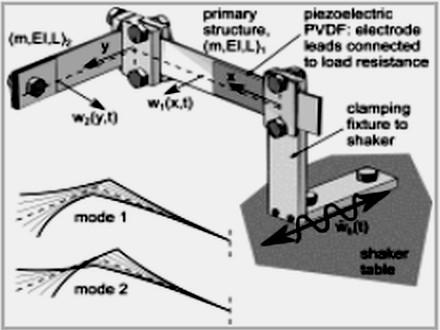
One of the articles that I saw a couple of months ago, which was sitting on my blogging back burner, was one on the development of artificial “trees”. Of course, when you hear the words artificial and tree together, you think artificial Christmas tree (or at least I did), but the artificial trees in question here are “tree like structures” that don’t really look like trees. You tell me: does this look like a tree?shakertree440

The trees have been developed by University of Ohio researchers, and will “be used at the small scale to power sensors that monitor the structural integrity of buildings, bridges and other civil engineering structures.”

“’Buildings sway ever so slightly in the wind, bridges oscillate when we drive on them and car suspensions absorb bumps in the road,’ said project leader Ryan Harne, assistant professor of mechanical and aerospace engineering at Ohio State, and director of the Laboratory of Sound and Vibration Research, in a statement. ‘In fact, there’s a massive amount of kinetic energy associated with those motions that is otherwise lost. We want to recover and recycle some of that energy.’ Harne envisions tiny “trees” feeding voltages to a sensor on the underside of a bridge, or on a girder deep inside a high-rise building. In this way structural monitoring systems could be powered by the vibrations they are monitoring.”
(Source: EE Times)

This is certainly an interesting application, and I suspect we’ll be seeing more of them.

What’s held energy harvesting back has been that it has been more costly when compared to battery power, but this is changing. But as prices go down – and devices become less power hungry –  adoption will be more widespread. This will impact the semi-conductor market. According to Semico Research firm, energy harvesting “will drive semiconductor sales worth $3 billion in 2020,” substantial growth from the $200 million value in 2015.” (Source: EE Times)

One great thing about energy harvesting – other than the free part – is that the sources of energy are renewable. Whether those artificial trees really look like trees won’t matter. They’ll be tapping into – make that scavenging – an excellent source of power.


Built to last? Not for some products

At Critical Link, the applications that we get involved with tend to fall into the category “built to last.” We work with complex, heavy duty products – medical and scientific applications, test and measurement, transportation, defense. The applications we work on do their job, and do it well. Part of doing their job well means that they’re based on technology that is robust, suited to the purpose, and has a long shelf life. Yes, we all – Critical Link and our customers – are always up on the latest, but we’re not about throwing things out that work perfectly well just because something that may seem a little shinier comes along.

Anyway, our approach is unlike that of most consumer electronics, which are only built to last up to a point. They’re meant to go obsolescent within in a couple of years. Even if they still “work”, they’re not fast enough, cool enough, shiny enough. So they get tossed in a drawer or thrown in a bin and replaced. And sometimes – as can pretty easily happen if the app is in the cloud – they just get shut down outright.

What got me thinking along these lines is an article I saw in Wired a few weeks back on Nest’s plans to shut down Revolv’s smart home hub.

Revolv is – and soon to be, was – a $300 hub that could control a variety of different gadgets from a single smartphone app. It was backed by a cloud-based service: no cloud-based service, no control.

revolv_nest

In 2014, Nest (now part of Google-world) acquired Revolv. They immediately stopped selling the hubs, but kept up support for a while. But they’ll be cutting it off mid-May.

The old Revolv web site tells users what they need to know – but may not want to hear:

What happens to my Revolv service? As of May 15, 2016, Revolv service will no longer be available. The Revolve app won’t open and the hub won’t work.

Is my product still under warranty? No. Our one-year warranty against defects in materials or owrkmanship has expired for all Revolv products.

What will happen to Revolv data? Revolv data will be deleted. 

How can I get customer support? If you’re a current Revolv customer, please email us at help@revolv.com so we can help you out during this tranition and provide you with a purchase price of your Revolv hub.

That last point, I take it, was something of an afterthought. There were no plans in place to offer a refund until customers started squawking.

The author of the Wired article uses the Nest-Resolv situation to cast doubt on whether the Internet of Things is going to work out or fizzle out.

I’m a believer that it will work out. The establishment of industry standards, which I wrote about last week, will help. So will, as Wired suggests, making “it possible for the devices to work independently of their cloud services over WiFi or Bluetooth”, which will enable you to “use your phone to control a device like the Revolv hub without an Internet connection, even if the thing is sitting 10 feet away from you.”

At this point in time, we don’t know exactly what’s going to happen with the IoT. I just hope that they don’t start building in obsolescence to big-ticket items like refrigerators and stoves as they get smarter and smarter.


Standardization comes to the IoT

Don’t know whether you caught the news, but earlier in the year a consortium of tech companies released the specs for a new Internet of Things (IoT) sensor platform, M2.COM. The entities include ARM and one of our partners, Texas Instruments.

This is a welcome development, as the IoT – especially with so many consumer devices coming quickly on board – is growing wildly. We’ve all seen the forecasts, and they are wild. Last fall, Gartner predicted that there would be over 6.4 billion connected things in use this year – and that more than 5 million new things will be connected each and every day. At the rate the IoT is growing, Gartner forecasts more than 20 billion connect things by 2020.

It’s not just the forecasts that are wild. In some sense, with the rush to get “smart” and connected products out there, the development efforts have been wild themselves.

Now the consortium has stepped forward to propose a standard platform that means developers won’t have to start from scratch each time they build a new IoT product. This will minimize development time, while also providing developers the degree of sensor flexibility they need for their varied applications. The thought behind it is that it’s not really the “thing” (i.e., the hardware) that matters in the IoT. It’s the data being gathered that gives the IoT its potential. The easier you can make it to gather that data, the more rapidly that IoT potential will be realized.

The platform has adopted the M.2 form factor. (Thus the name M2.COM…)

“The module combines general wireless connectivity with an MCU, specifically, TI’s SimpleLink Wi-Fi CC3200 wireless MCU. Around that, ARM adds its embed OS support, Bosch adds its MEMS and sensor technologies, Sensirion brings its own wide range of sensors to the party, while Advantech adds its embedded systems design expertise.” (Source: Embedded.com)

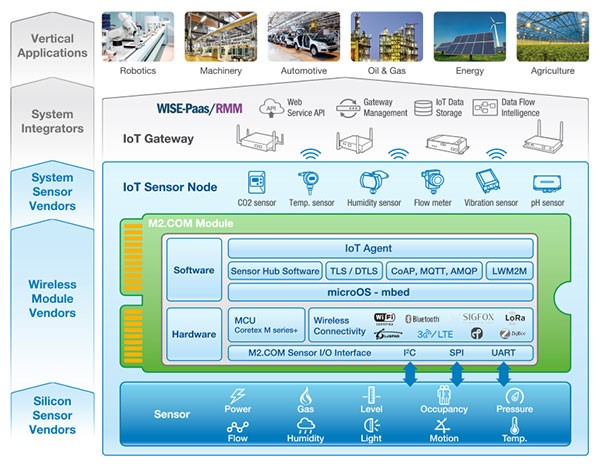
Shown here is a particularly interesting graphic that depicts what’s going on with the new sensor platform. This appeared in a linked article in Embedded.com’s sister publication EDN.

M2.COM 2

A few things worth pointing out: the M.2 form factor is small (only 30×22 mm), yet still has a 75-position host interface connector – plenty of room to support all the features needed. Also worth noting is the ARM Cortex M processing core is low-power.  Finally, the design supports a broad range of sensors. The flexibility built in to this platforms says that it’s open to expanding the platform’s overall ecosystem – plenty of room for vendors beyond the initial six in the consortium to participate.

IoT development’s been pretty wild, that’s for sure. It will be interesting to see how widely this platform will be adopted.


The Internet of Fishing Fleets

When we think about the Internet of Things (IoT), for most of us, the first thought is probably a Nest thermostat or some other connected appliance or home device, or a fitness application like FitBit. These are the applications that get the most buzz, and are the apps that are apt to make up the bulk of the kabillion things that are expected to be connected soon. Okay, kabilllion may not be quite right. But Gartner is forecasting over 6 billion connected things will be in use this year, with more than 5 million new ones connected every day. Those numbers are coming from consumer, not industrial and commercial applications.

But many of the most challenging, interesting and very worthwhile uses for IoT aren’t going to be in our houses or on our wrists.

Some of these were mentioned in a brief article I saw in a recent Fortune.

The article talks about how some cities are using IoT to save money and deliver services more efficiently. New Bedford, Massachusetts, for example, uses on-truck sensors to detect whether roads are warm enough to melt snow or whether they need to send out the plows. But New Bedford doesn’t just have a lot of roads to get plowed in the winter; it’s also home to one of the country’s largest fishing fleets. And Inex Advisors, an investment firm that’s located in the city, sponsors IoT research, some of which is fishing-fleet related.

Working with “local fleet owners and operators,”

“Inex’s IoT Lab, with backing from Analog Devices is looking to put instruments on vessels to ease and track fish counts, a key concern in this heavily regulated industry. “What gets caught where and by whom matters a lot and can make a trip either profitable or unprofitable,” [New Bedford Mayor Jonathan] Mitchell said.” (Source: Fortune)

Sophisticated technology has been deployed for maritime uses for a long time now. But all the technology is running up against the fact that many fisheries have been fully depleted, or are in danger of becoming so. Because of this, there are new government mandates that are going into effect later this spring that will require that “vessels catching certain fish must carry a human monitor to watch the quantities and species of fish caught.” Having to pay for an onboard fish watcher would be quite costly.

“A possible solution is to use cheap, fast sensors aboard the boat to document the catch. Inex is currently working with the commercial fleet operators to help them comply with the catch share regulations and also to monitor “bycatch,” translating to the unwanted fish or other wildlife caught in fishing operations.”

Sound like an application that will be able to help fishermen operate more efficiently, while also helping save fishing grounds and certain species from being destroyed. They probably won’t be deploying 5 million of them a day, but, when it comes to growing the IoT, every little bit helps.


Neuro Computing. (This is some pretty powerful stuff.)

Many years ago, I heard it said that, at the time of the introduction of the steam engine in England, the changes over just one generation were so profound that a parent born before the Industrial Revolution had more in common with someone from the Stone Age than they did with their own children. With technology moving so fast, it’s sometimes hard not think that the same thing is happening now. Maybe the changes aren’t quite as profound – as someone who was born during the era when computers became a daily reality, I still do have plenty in common with my digital native kids. (They may think of me as Stone Age, but I know better.)

Major changes do seem to be occurring more rapidly than they did when the steam engine led to the emergence of a manufacturing economy.

These musings came to mind when I saw an article on neuro computing on EE Times.

The article was about IBM’s “brain-like chips”, which are being used at Lawrence Livermore National Laboratory (LLNL) “for simulating the deterioration of our aging nuclear arsenal—currently the most difficult problem for supercomputers to solve worldwide.”

The new neuro computing technology will be concentrated in areas of importance to the National Nuclear Security Administration (NNSA): cyber security, nuclear deterrent, non-proliferation.

According to Dharmendra Modha, IBM fellow and chief scientist for brain-inspired computing at IBM Research-Almaden:

“NNSA’s Advanced Simulation and Computing (ASC) program will evaluate machine learning applications, deep learning algorithms and architectures plus conduct general computing feasibility studies. ASC is a cornerstone of NNSA’s Stockpile Stewardship Program to ensure the safety, security and reliability of the nation’s nuclear deterrent without underground testing.” (Source: EE Times)

IBM’s neuromorphic computer packs an awful lot of punch in a small form factor, and with low power consumption:

“The 16-chip neuromorphic system represents 50 times the computing power of today’s computers,” Modha told us. And consumes just “1/10th the power of a dim lightbulb.”

This neuro computing – which IBM has branded True North – deploys “deep learning supported by hardware that emulates 16 million neurons and 5 billion synapses.” IBM believes that their approach will prove better than massive multicores and other processing schemes.

The article gets into some detail on how TrueNorth works, and is definitely worth a read. (There’s also an info-graphic if you don’t have time to read the full piece.)

I’ve seen an awful lot of technology changes in my lifetime. With our smartphones, we’re all carrying the equivalent of yesterday’s mainframe in our pocket. And there’s no underestimating the changes that have been brought about by the growth of social media. At Critical Link, we’re constantly seeing changes in computing power, size, and power consumption, and incorporating these changes in our SoMs.

But “50 times the computing power” and “1/10th the power of a dim lightbulb”?

Easy to see how you can start to feel like you’re a Stone Ager!

Exploring TCO: Single Board vs. SOM Solution

Once again, we’ve posted an article on the ARM Connected Community info forum. This time, we explored the Total Cost of Ownership for a single board solution vs. a System on Module (SOM) solution.  Our analysis turned out to be pretty interesting. If you just look at the recurring costs of both approaches, the single board will be lot cheaper. But when you factor in the engineering costs, things look different, and a SOM becomes the way to go for many industrial and medical applications (those with large, but not astronimcal, consumer-market level volumes).  There are other benefits as well, including time to market and the fact that using a SOM will let your engineering staff focus on what’s unique about your product, without having to worry about reinventing the wheel. That’s our job, and with our SOMs, we’ve done it!

Anyway, as we mentioned with respect to our prior article, there’s nothing particularly ARM-related about it, so don’t be turned away if you’re not doing any ARM development. The article can be found here.

Name that variable!

For all the software guys and gals out there, earlier this week, I saw a somewhat funny, somewhat cranky, and mostly insightful article by Jack Ganssle, which appeared on embedded.com.  His topic? How we name things – functions, variables, parameters, macros, identifiers – when we code.

Now coders tend, by their very nature, to be logical and to think things through. So it’s not as if no thought is given to naming. It’s just that, as Jack points out, what might seem logical to us may not be so logical to someone picking up the code and trying to figure out what’s going on when, years later, they inherit it.

Jack starts out with a critique of the names for the logging levels for the Linux printk function, starting with KERN_EMERG.

“What, exactly, does EMERG mean? Emergency? Emerging? Emergent? The latter sounds like part of the title of a horror movie.”

Okay, this is funny, but I think that most of us would see this and think “emergency,” which is, in fact, what it stands for. Still, the point it well taken.

He’s not arguing, by the way, for long names that spell everything out in hopes that this approach will “yield self-documenting code (which isn’t true).”

But all this abbreviating we do doesn’t help much either, since it can cause confusion. As in “emergency” vs. “emerging.”

As he says:

“The code has to do two things: work, and express its intent to a future version of yourself or to some poor slob faced with maintaining it all years from now after you’re long gone. If it fails to do either, it’s junk.”

Let’s all keep in mind that the naming goal should always be clarity, and sometimes it’s best to add a few characters to help eliminate confusion.

The article is definitely worth a look, as are the comments.

Anyway, I was discussing this topic with a friend, and she told me about a couple of mainframe software coders she worked with back in the day. One would write error messages using non-English words, and/or throw in literary references. Her favorite was the message that said “something gang agley here,” which combined a foreign language that few were familiar with (Scots) and a nod to Scots poet Robert Burns, who wrote “the best laid plans of mice and men gang aft agley,” which means often go awry. A couple of things worth noting here: error messages really aren’t the place to show off your obscure knowledge, and, two, an error message that says ‘something’s gone wrong’ isn’t exactly being informative, now is it?

The other guy she mentioned also got creative with error messages, but he went in for insults. As in “if you’re getting this error message, you’ve done something really stupid.” Just what one of your end-users or customers wants to see!

So, if you’d like to do some thinking about how you go about naming, take a look at Jack’s column. And when you’re writing error messages, keep in mind that the purpose is to inform, not confuse or insult.

Bare board cost: the effect of HDI and layer count

BareBoard Cost DriversAs we did earlier in the year, we had an opportunity to post an article on the ARM Connected Community site, an information-sharing forum for those interested in ARM. Our post, the Effect of HDI and layer count on bare board cost, appeared yesterday.

The article was in response to a questions we’re asked pretty often: how do you cost-out the differences between a single board chip-down solution and a solution that incorporates a SOM. We got some board prices and did our analysis, and were surprised – make that shocked – at the delta between bas board costs for a 12-layer HDI board and those for a 6-layer board that leverages a SOM. We were also interested to learn that board size was pretty much irrelevant.

The post is not particularly ARM-related, so even if you’re not doing ARM developement, you might want to check out the post and see what our analysis found.

Fast as lightning! That would be Li-Fi.

I’ve been hearing a lot about Li-Fi lately, which is getting plenty of hype in the tech press. And why wouldn’t it be getting hyped? It promises to be 100x faster than standard Wi-Fi speeds. Which would make it pretty darned fast. We’re talking instantaneous download of full-length videos here. (Or, as it said in the article I saw on Yahoo on this topic, speeds that are speedy enough to “download the equivalent of 23 DVDs in one second.” Not that I have the need to “download the equivalent of 23 DVDs in one second, but cool technology nonetheless.)

Just what is Li-Fi?

For starters, the “Li” stands for Light, as in Light Fidelity, based on Visible Light Communication (VLC), which uses visible light between 400 and 800 terahertz.

“The technology uses the frequencies generated by LED bulbs — which flicker on and off imperceptibly thousands of times a second — to beam information through the air, leading it to be dubbed the “digital equivalent of Morse Code”.”

Much of what’s been happening with Li-Fi occurred in labs, but it started coming into real-world settings in 2015, when testing occurred in some museums and malls in France, which is a hub spot for Li-Fi. It’s also been tested out in other countries – Belgium, Estonia, and India were named, and:

“Dutch medical equipment and lighting group Philips is reportedly interested in the technology and Apple may integrate it in its next smartphone, the iPhone7, due out at the end of the year, according to tech media.”

So Li-Fi will be getting here sooner rather than later.

Proponents of the technology point out that as the IoT expands – the predicted number of devices by 2020 that I’ve seen floating around is 50 billion – Wi-Fi will start running up against a depleted supply or radio wave spectrums.

On the downside, Li-Fi (unlike Superman’s vision) cannot go through walls, which would mean, if you had it in your home, you’d need to be set up for it in every room where you wanted access. Devices would also have to be equipped with a dongle or some other type of add-on technology in order to work. This would up the cost, at least in the short term. If Li-Fi takes off, the technology to make it work would eventually become embedded.

So, of course, we’ll be working with it!

Despite the limitations, there are a number of areas where Li-Fi will be very useful right off the bat. For example: a hospital setting, given that it wouldn’t interfere with medical equipment. And because “Li-Fi can potentially be directed and beamed at a particular user”, it would be good for security and privacy.

For now, it’s mostly lab science, but this may be the year that Li-Fi starts to break through.

Let there be Li-Fi!

———————————————————————————————————————————

If you’d like to read more, I found that Science Alert, Hackaday, and Tech World had interesting pieces.