What I missed at CES 2018

I’m always curious about what goes on at CES, the mega consumer electronics show held in Las Vegas every January. Consumer is not the market that Critical Link typically plays in, but the types of technology that make their way into consumer applications are the types of technology that make their way into industrial and scientific applications. Sure, the scale is different. The power, performance, availability, and security requirements are different. And no one who develops industrial-strength applications builds in obsolescence in hopes that users will trade up in a couple of years. Still, the technology trends are similar. And those consumer apps are certainly interesting.

Anyway, I got to attend CES 2018 vicariously by reading about it, including an article by Junko Yoshida on EE Times, who poked around the CES Unveiled showcase to see what’s up. He found:

Above all, a common thread among the many gadgets “unveiled” is “sensing.” Afoot is an escalating race for not just many more, but higher performance sensors to be embedded everywhere.

Sensing, eh? As I said, there’s plenty of commonality between consumer technology and industrial technology and, at Critical Link, Sensors ‘R’ Us, pretty much.

Here’s what caught Junko’s eye at the show:

Consumer Physics has come up with the SCiO. This device – near-infrared spectroscopy that relies on LED light – is aimed at making grocery shopping smarter by sensing the fat, sugar, water and protein content of food. Prepared foods, of course, provide details on calories and contents, but SCiO will work with fresh foods, which will help gauge freshness. Guess this means that the old ways – like sniffing and touching the cantaloupe – will become lost arts, like reading a map.

And speaking of sniffing, Sniffy, a prototype “embedded with a camera, a touch screen and a host of test tubes packed with olfactory stimuli” can analyze shoppers’ reactions to odors, which are triggers for emotional reactions, and can “generate big data that can be used for marketing.”

Debussy is a high-end headset from Funky Sound Studio. It’s a “smartphone inside a headphone” and uses ARM Cortex processors. Not the same ones we have in our MitySOM-5Csx, but as I said, the technology in consumer apps and industrial apps tends to differ in degree rather than kind. No pricing available yet, but, let’s face it, the word “luxury” gives us a hint.

3DRudder demo’d a foot-operated joystick to be used to immerse yourself in VR. The 3DRudder would take care of the pushing, tilting and rotating motions, while the hand controller would be dedicated to shooting, grabbing, and hitting. There’s also a wireless VR system from Display Link Corporation.

The Relync mobility looks like assistive technology at its best: a portable scooter that folds up into the size of a suitcase. Looks like folks who rely on scooters to get around will have an option that’s a lot less cumbersome, certainly making travel easier.

I’m really intrigued by what French research institute CEA Leti’s up to:

This year, CEA-Leti is applying [their low-power sensor] fusion to the first 3D anti-crash solution embedded in a drone…a tiny drone embedded with six lidars, a camera and radar that fits on [someone’s] palm…The key here is that this 360 Fusion can fit into a low-cost, mass-market micro, such as STMicroelectronics STM32. This miniature drone with integrated with perception solution weighs less than 40 grams.
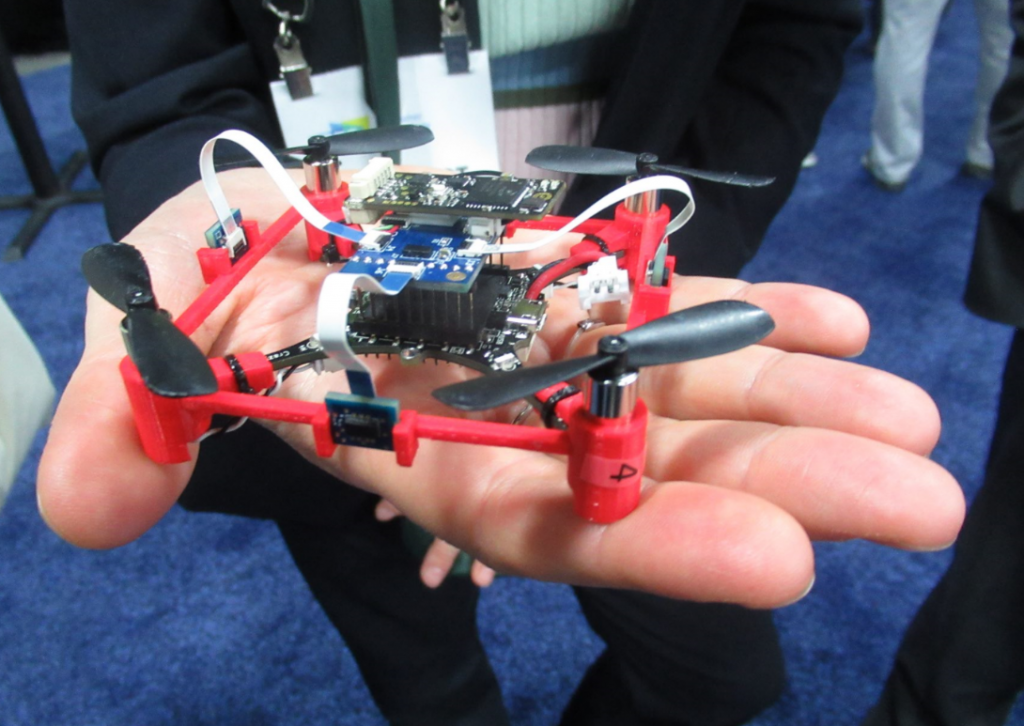
With more and more drones taking to the skies, anti-collision technology is most welcome.

While it’s being demo’d at a consumer show, the Acute Angle PC is geared toward the enterprise.  This PC “can work during off hours as a mining machine for a decentralized public blockchain platform. The Acute Angle PC works for Acute Angle Cloud, a globally distributed Location as a service (LaaS) platform.”

Back to more consumer-oriented gadgets, the SGNL watchband vibrates when you get a phone call on your mobile, which you can then answer by just “putting your finger to your ear.”  And Buddy is a robot that watches the kids. Not sure I would have trusted my kids to a robot babysitter. But I might trust Caveasy, a smart wine rack that lets you snap a picture of the labels on your bottles and then advise you on when it will be best to drink it and what food it will go best with.

And all I can say about the Aurasens lounge chair that “penetrates your senses with Mozart and Manilow” is that, at $22K, there won’t be one in my den anytime soon.

Thanks, Junko, for letting me see what I’m missing at CES 2018.
Tech Trends 2018

Like everyone else in the world, when the new year rolls around, I start thinking about what’s going to happen in this bright and sparkling new year. And I’m curious about what others are saying about what’s going to happen.

It’s pretty easy to satisfy this curiosity. Just google ‘tech trends 2018’. That returns around 22 million results. Or if you want to refine your search a bit, look for ‘embedded technology trends 2018.’ That will narrow the results down substantially, to just a bit under 16 million.

Even though last week was a slow week, I did NOT have time to browse 16 million articles, let alone 22 million.  But I did take a glance at a few in each category, and here’s what I found most interesting.

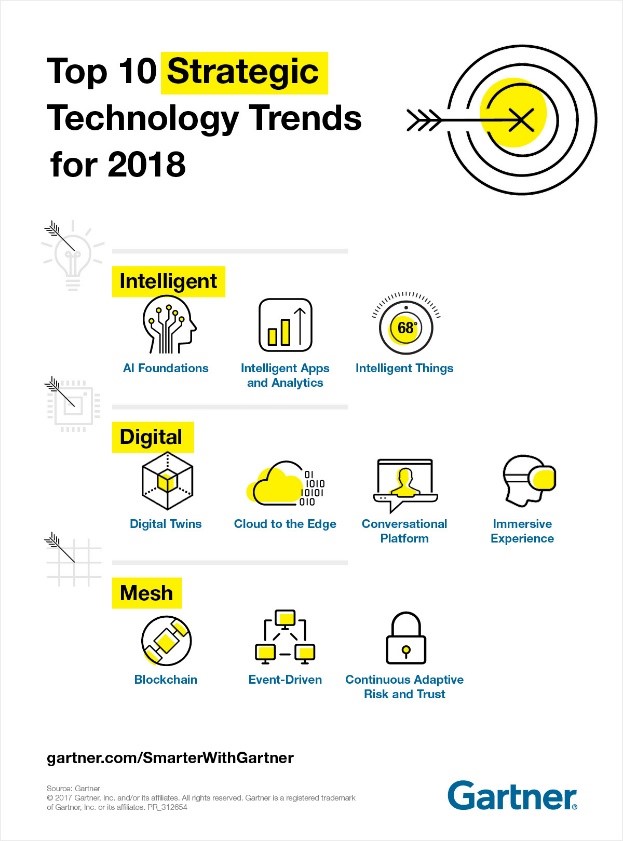
Gartner has a way of boiling things down and communicating them succinctly. Here’s their Top 10 Strategic Technology Trends for 2018. And they even provided it in a handy, boiled-down and succinct infographic.  This is what they’re calling the “intelligent digital mesh”, and it’s more or less that same thing they identified as trends for 2017. (There are a few changes: Immersive Experience was called Virtual & Augmented Reality last year; and last year Conversational Systems were part of the Mesh, while for 2018 it’s a Conversational Platform, and it’s now part of Digital; etc.) It isn’t surprising that the trends stay pretty much the same. While there are occasional fads (mostly on the consumer side), trends tend to develop over time, and there are seldom any truly startling or disruptive changes from one year to the next.

Anyway, I wouldn’t have thought of Critical Link as being part of the “intelligent digital mesh,” but although we don’t hit on all these aspects, this is pretty much the terrain our core technology, and the apps its embedded in, inhabits.

Over on Fortune, Jay Samit sees four transformative technologies on the horizon for 2018, most notably that the Internet of Things gets a new first name. From here on out, it becomes the Blockchain IoT.

Combining IoT with blockchain —or BIoT—ushers in a whole host of new services and businesses. For example, BIoT can be used to track shipments of pharmaceuticals and to create smart cities in which connected heating systems better controls energy use and connected traffic lights better manage rush hour.

In 2018, companies will begin to use Application Programming Interfaces, or software used to connect different databases and computer services. Combined with the blockchain Internet of things, it will be as easy to get data from sensors in a warehouse as accessing websites on our mobile phones. When manufacturers, retailers, regulators, and transportation companies have real-time data from sensors imbedded on products, trucks and ships, everyone in the distribution chain can benefit from insights that they were previously unable to get. With BIoT, companies and consumers can also be assured that their most valuable data on the blockchain cannot be hacked.

His other takes on transformative technology – financial-related technology (including cryptocurrency), augmented reality going mainstream, and 2018 as “the year of the bots” are also worth looking through.

Tim Bajarin, writing for PC Magazine, has things to say that are a combination of frightening and fun. On the frightening side, he predicts that North Korea, Russia, and China – and the “armies of hackers” they fund – will be after everything they can get their cyber hands on, including the mid-term elections. In light of this, he believes that Washington (both sides of the aisle, I might add) will step up their game with respect to social media regulation. On the fun side, Bajarin sees that there’ll be no escape for Augmented Reality, that there’ll be laptops available with a 20 hour battery life (yay!), and – the most fun – we’ll see market-ready foldable smartphones and tablets by the end of the year.

I could go on, but I don’t want to spoil all the fun for you. After all, there are millions and millions more articles where these came from.

The Tech Toy Shopping List for 2017

It’s only December 6th, so there’s still some time to do your holiday gift shopping. And, of course, thanks to Amazon, you don’t even have to leave your reclining chair to get your shopping done.

One thing I like to look this time of year is the tech toys for kids. Last year, just about this time, I blogged about Simon Hill’s article on digital toy trends. This year, what caught my eye was the New Atlas round up, by Michael Irving, of tech toys for 2017.

Remember when kids used to race their hot wheels by running them back and forth and saying “zoom, zoom – or was it “vroom, vroom”? Maybe because I was one of them, I sure do. But Hot Wheels have gone high tech, via Hot Wheels Osmo MindRacers.

After the MindRacers kit is hooked up to an iPad, players launch their cars “into” the screen to race or battle each other. The game plays out both on- and off-screen at the same time, with the kids controlling their cars by slapping down tokens in front of the camera, boosting themselves or attacking their opponents, Mario Kart-style.

Zoom, zoom. Vroom, vroom.

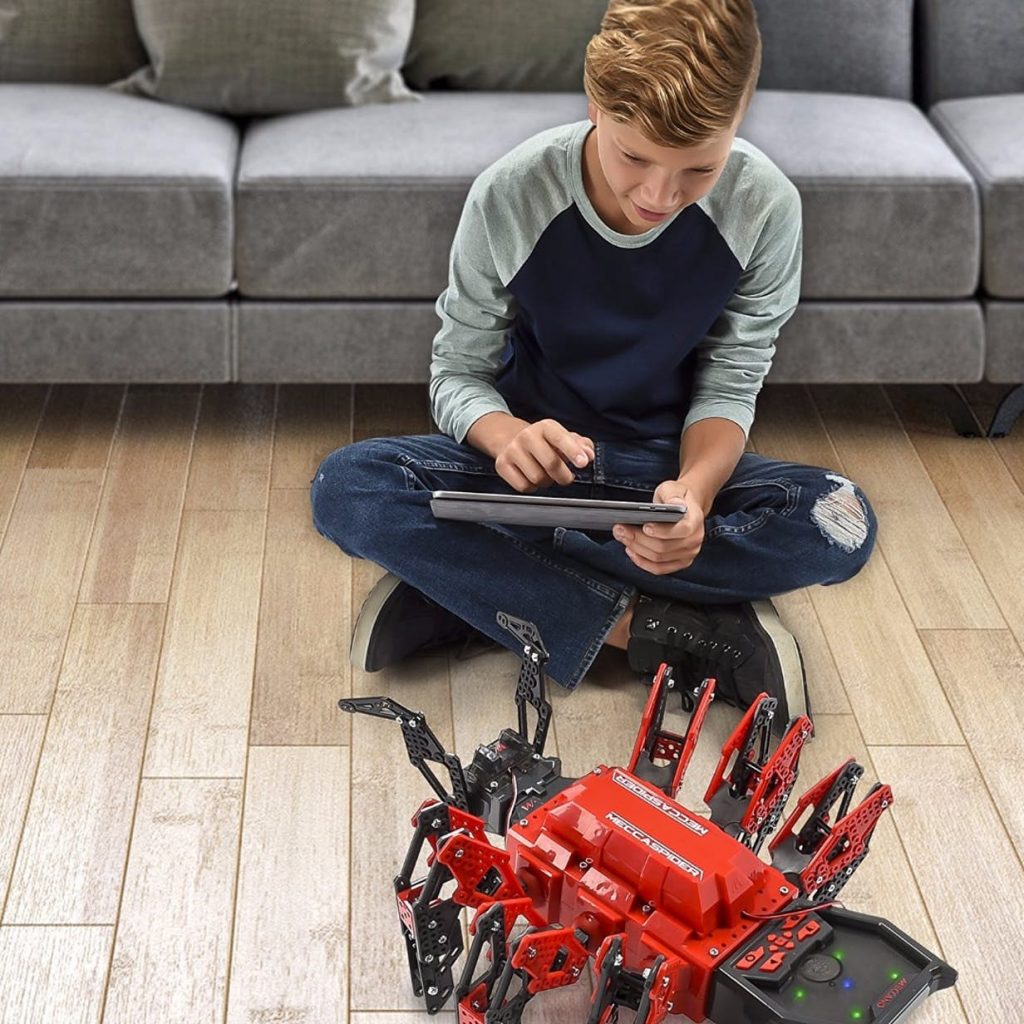
The Meccano MeccaSpider combines the erector set we all grew up with robotics and a programmable app that let’s you control the what you build. Given that our products and the applications we work on are hardware with programmable elements, this is the type of toy that makes me wish my kids were still kids. Or that I was still a kid. Irving calls it the perfect STEM toy. I agree.

No surprise, there are robots on the list. No surprise there’s Star Wars on the list. In this case, the Sphero R2-D2 & BB-9E are droids that are operated via a smartphone app. And they’re Star Wars characters – lovable old-school R2-D2 from the original movie from way back in 1977, and the evil-ish BB-9E from the most recent edition. There’s also a Sphero Spiderman. Same plot: robot run from an iOS or Android device.

Nintendo’s going retro with the Super Nintendo Classic Edition.

This retro rerelease is a palm-sized version of the must-have home console of the early 90s, preloaded with a greatest-hits list of games that includes the likes of Mario, Donkey Kong, Zelda, Kirby, Metroid, Street Fighter and Mega Man. Plus, the long-lost Star Fox 2is playable for the first time ever.

Be forewarned: it may be hard to get your hands on this. It’s pretty popular and selling out in some places.

Virtual reality makes its appearance with VRSE, a VR system aimed at and priced for the kids. There are two games available – Batman or Jurassic Park –  but can be used by the grownups to play other games, “360-degree videos and even fly FPV-enabled drones.” Sounds like a bargain.

Mardles AR storybooks may look (and read) like any old regular paper and cardboard picture book, but if you look at them through a phone or table app, the augmented reality kicks in, the book turns 3D, and the kids can “interact with the characters and objects.” I’m torn on this one, as there’s something to be said for kids interacting with characters and objects in their imaginations.

You might have been wondering where the drones are on the list. They’re here with the Extreme Fliers Micro Drone 3.0+. And while we’re on the subject of flight, there’s the NASA Apollo Saturn V rocket Lego set. It may not actually take flight, but it makes a pretty good replica of the real thing, and will definitely get kids thinking about space (and how we got to explore it). And, with nearly 2,000 pieces, it’ll teach the kids a thing or two about building.

The final item on the New Atlas list is the RazorX Cruiser electric skateboard. Skateboards are more stable (4 wheels vs. 2) than hoverboards. Plus there are no incidents that I know of in which an electric skateboard has exploded.  Still, I think I’d rather see a kid on an unelectric, foot-powered skateboard.

But the fact is that anything that can be electrified will be electrified with the possible exception of some t

oys that are based on the technology available during the Renaissance. These aren’t on the New Atlas list, but are nonetheless based on technology (and pure inventive genius) of yore. They’re the Leonard da Vinci kits, which let kids build one of Leonardo’s invention – the ornithopter, catapault, pendulum clock… But with all the breakthroughs that are occurring with autonomous vehicles. I’d go with the self-propelled cart. Interesting, fun, and no electronics, AR, or VR involved!

Enjoy your shopping!

An anti-poaching collar: yet another interesting application using sensors

In today’s world, sensors are embedded in just about anything you can think of – from complex industrial and scientific equipment to – more recently –  common everyday items. And then there are the applications that fall somewhere in between.

Sensors have long been in use to track wildlife, but an application I recently read about was a new one on me.  Ákos Lédeczi is a professor of computer engineering at Vanderbilt, and George Wittemyer teaches in Colorado State’s department of fish, wildlife and conservation biology. They’re designing an anti-poaching collar designed for use with big game in Africa, which they wrote about in an EE Times article.

The issue they’re talking is a big one. Just look at the African elephant population. The number of elephants in Africa has declined by more than half over the last 40 years, and this magnificent animal now risks extinction. To help solve this problem, the two decided to collaborate on their anti-poaching collar.

Together we created a scalable gunshot detection system for wildlife we call Wiper which stands for wireless anti-poaching collar for elephants and rhinos. It’s a novel sensor that aims to disrupt poaching by monitoring an animal wherever it may roam.

The majority of existing solutions are based on ground or aerial sensors that can be ineffective for an elephant’s immense range of movement. Wiper combines two modes of sensing–behavior-change-based alerts and acoustic-shot detection. Together they deliver a near 100-percent shot detection rate.

By pairing technologies that monitor animal behavior like GPS tracking collars with our own acoustic sensors, we are able to immediately identify the occurrence and location of gunshots. Immediately following this detection, authorities are notified through cellular or Iridium modems and deployed to the area. (Source: EE Times)

To ensure that poachers using gun mufflers or silencers don’t thwart the system, they deploy fool-proof ballistic shockwave detection.

Ballistic shockwaves have a unique n-wave pattern which exhibits high energy, short duration and very fast rise times. Paired with GPS tracking collars to identify the location of the incident, the shockwave of the bullet is detected even before the muzzle blast reaches the animal.

Unfortunately, the technology won’t save the animal that’s been shot, but it will make it easier to apprehend poachers and prevent further killing.

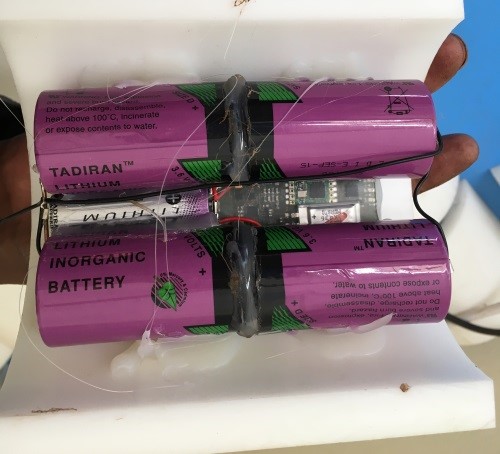
One area that they had to grapple with was power management. The Wiper needed to last two years.  Fortunately, elephants are big fellows that can handle wearing four of what appear to be D-sized batteries around their necks.

One of the most exciting things about technology is reading about the many and varied applications it’s being used for. This is just another example, but it’s  good one!

Filling ‘er up gets the Faraday treatment

At one point or another during our driving lives, most of us have had the dreaded experience of noticing that we’re pretty much running on empty, and we make it into the gas station on fumes. Gas gauges are so much more sophisticated these days, even telling you how many miles you have left in the tank, that there are fewer worries that we’ll be the one walking on the side of the road, carrying the tell-tale red plastic gas can. In any case, unless we’re in the middle of the nowhere, we can usually count on there being a gas station around when we need one.

Then there are electric cars, where the “filling stations” – i.e., the charging points –  aren’t so prevalent, and the model for the world of electric vehicles hasn’t yet been perfected.

One thing that’s obvious is that, for a lot of reasons, the plug-in-and-charge method is not without its problems.

So . The method applies the principle discovered by Michael Faraday – way back before cars even existed – to today’s electric vehicles. To brush you up on Faraday’s work:

[Faraday] observed that moving a conductor through a magnetic field induced a current in that conductor. Subsequent investigations showed that this also works if the conductor is stationary and the magnetic field is moving. Since electric currents generate magnetic fields, and if the current alternates so does the field, an alternating current creates a field that is continuously moving. This means that running such a current through a conductor will induce a similar current in another, nearby, conductor. That induced current can then be used for whatever purpose an engineer chooses. (Source: The Economist)

To fill those electric vehicles up, the first conductor is composed of copper wire coiled around some ferrite. This is encased, creating a flat pad that can be buried. The vehicle gets outfitted with a pickup coil, and when its stopped over the spot where the pad is buried, induction works it magic and the car’s battery is recharged.

Having the buried charging pad and embedded pickup gets rid of one of the objections to electric vehicles: the unsightly clutter that plugs and cords involve. (Not to mention the tripping hazard and the fact that someone can unplug you if they’re so inclined.) The solution, however, does nothing to address the challenge of finding charging stations, nor does it address the fact that recharging a car’s battery takes quite a bit longer than filling your guzzler up with gas.

The ‘where’ and ‘how long’ challenges are being addressed by a couple of companies experimenting with electrified roads. This will let vehicles charge while they’re on the move. Of course, this involves digging up roads, laying down the conductors, and repaving when they’re done, which sounds somewhat costly.

Anyway, it’s interesting to see the Faraday approach applied finding a better way to keep electric vehicles up and running.


Sensor Proliferation

Two things that tend to capture my interest in an article are sensors and cars, and Bill Schweber’s entertaining post in a recent EE Times featured both. So I was entertained.

He started out with the familiar problem of the “check engine” light coming on.  We’ve gotten so used to that warning that most of us no longer feel we need to high-tail it into the dealer before the engine explodes. Instead, if you’re an engineer and/or a car guy, you do a bit of poking around to figure out what the problem is. (In Bill’s case, it was a “faulty sensor in the coolant system.” Good – I guess – to learn that fault wasn’t in anything to do with the actual operation of the car, but with the sensor.

As Bill points out, our cars are equipped with an ever-growing number of sensors. This, in turn, will lead to those pesky false alarms.

To me, the modern super-sensored car is a forerunner of the much-heralded Internet of Things (IoT). Indeed, for many car models, it is an IoT scenario as the car is connected back to the manufacturer to report various readings, status, and events, like it or not. Whether the car is directly connected as an IoT node or not, today’s cars are sensor-laden vehicles with self-awareness of many temperature, pressure, flow, and switch-on/-off readings. We’re told that this is all good.

But I’m not so sure. As any experienced engineer knows, sensors are the most vulnerable part of a system. Due to their inherent role, sensors are exposed to the nasty real world of moisture, vibration, temperature, and other physical stresses to a lesser or greater extent. Sometimes the exposure is directly due to what is being monitored, but often it is a side effect of monitoring some other parameter. Regardless of the cause, sensors live a much harder life than the electronics on the typical PC board, even if that board is in an automotive environment.  (Source: EE Times)

He then talks about the problem of sensor proliferation which is that, with so many sensors the potential to throw off more and more false positives and negatives, testing and assessing – and figuring out how to test and assess – is becoming more and more difficult.

Bill offers a couple work-arounds that, as he points out, aren’t so great. One is adding redundant sensors and interface circuits. A second is “to implement a true, independent, closed-loop test of the sensor performance,” which is practical for some situations, but not for others.

There are two main outcomes to the increasing number of sensors. One, people will have more and more alarms to ignore, and ignore them they will, given that so many of the warnings end up being false alarms. And two, “test engineers will have to spend even more time devising algorithms that correlate multiple sensor readings to see if they can “tease out” a better conclusion as to which readings are correct and which are in error.”

Fun read, this article. Definitely worth checking out if you’re a sensor and/or a car enthusiast.

Looking back on 20 great years

Hard to believe, but it was twenty years ago this past summer that four young (or youngish) embedded systems engineers –  John Fayos, Omar Rahim, Dave Rice, and myself – got together and founded Critical Link. And here we are, maybe not quite so young anymore, but all still together, working closely with our customers to help get their products to market faster than if they built them from scratch. I don’t know if there are stats readily available about our staying power – all of our “founding fathers” still working together – but I have to imagine that this is a rare accomplishment.

Our first and second official employees, Nancy Watterud and Zetta Fayos, are still with Critical Link as well, heading up our accounting team. Zetta and Nancy are among the more than 40 employees we have today. And while our back office staff has grown through the years, today the majority of our employees are still engineers. And one of the most gratifying aspects of my job is seeing the new young engineers coming along.

Looking back on our origins, in the early days our projects were focused in the rail industry. We still maintain a contingent of rail customers today, but have leveraged the experience gained there into other areas such as test & measurement, industrial automation, medical instrumentation, and, of course, imaging. In addition, as a result of being based in Syracuse, much of our staff has extensive experience in radar and software defined radio applications, which has created opportunities for us in the defense market.

Today, we work with customers ranging from promising start-ups to Fortune 50s. Products that we have designed are operating around the world 24/7. And products we’ve designed have won numerous awards. (Not to brag, but to name a few: R&D100, Processing Magazine’s Breakthrough Products of the Year, multiple Prism Awards, Vision Systems Design Innovator Awards, Plant Engineering Product of the Year, and multiple Best of NAB awards.)

And, of course, we have products of our own. They’re not standalone though; they’re embedded in our customers’ apps. The original Mity (read “Mighty”) system on module, the MityDSP-6711, was designed in 2003 and made commercially available a year after that. It’s still in production today, part of a continually growing family of MityDSPs and MitySOMs.

We also work with OEMs to design and manufacture custom imaging platforms around a wide array of image sensor technology. As with the MitySOM, a continually growing family.

Twenty years. I’m still trying to wrap my head around it! The kids who were babies when John, Omar, Dave, and I got together to found Critical Link are all grown up now. (Looking at them is when you realize you’re not a kid anymore, that’s for sure.) We’re all proud of our kids, and we’re proud of Critical Link. Proud of our employees. Proud of our work. Proud of our customers. Proud of our partners. Proud of our reputation.

Twenty years! There’s an Italian birthday greeting, cent’anni, that wishes someone a hundred years. I may not be around to see it, but I am taking note that we’re twenty percent of the way there.


Weather Forecasting

Over the past month or so, I’ve been keeping my eye on the news about hurricanes Harvey, Irma, Jose, and Maria. It’s hard not to get caught up in all the dramatic scenes, the rescues, and the incredible amount of information that comes pouring in. While the forecasts and models remain somewhat imprecise – think of the predictions of which areas in Florida would be hardest hit, and what the storm surges would be – they have certainly improved over the years. Today, the information may not have pinpoint accuracy, people are no longer caught unawares by a major storm.
What’s most interesting to me in all this is, of course, the underlying science and technology of weather forecasting, and ZDNet recently had a good article on it.

The article featured Scott Capps, who is an atmospheric scientist.

Weather models are at the heart of what Capps does. They are used both for forecasting and to recreate historical data. Increasingly however over the last decade machine learning (ML) has come to be applied in atmospheric science.

“Machine learning takes weather data and builds relationships between that data and whatever predictors we are interested in,” Capps explains. ML in atmospheric science is in its infancy, but it’s seeing exponential growth, and in that respect this domain is not different as ML is being adopted pretty much everywhere these days.

The problem is, ML won’t necessarily tell you why. As a scientist, Capps is always interested in knowing the whys. Not just to satisfy his curiosity, but for very pragmatic reasons as well. This would allow improving physically grounded models as well as providing more clear explanations.  (Source: ZD Net)

Those physically grounded models use satellite imagery and sensor data – primarily satellite imagery. Sensor data is “mostly used when doing predictions at a local, granular level to ground truth weather models, when using reliable equipment.”

However reliable the equipment and the forecasts are, weather systems are incredibly complex, and there’s still a lot of uncertainty around predicting the weather. That’s why we heard a lot about the “cone of uncertainty” around those hurricane forecasts.

Another interesting write-up on weather forecasting was on Motherboard.

Among the other topics hit on was the difference in accuracy between the US Global Forecast System and the European Center for Medium-Range Weather Forecasts.  When they’re tracking storms and projecting their trajectories, the meteorologists typically show both models.

These models take environmental data collected by remote sensors in the ocean, hurricane-tracking aircraft, and satellites as input for algorithms that create simulations of weather patterns on a global scale. (Source: Motherboard)

Five years ago, it was the European system that did a far better job predicting Hurricane Sandy. So, in Sandy’s wake, Congress decided to invest in some “serious computing power,” authorizing

… spending $48 million to improve weather forecasting to make sure that such a deadly and expensive miscalculation like Sandy didn’t happen again. Of this, $25 million was devoted a massive $44 million upgrade of NOAA’s computing architecture that was completed in January of 2016.

This upgrade—which added the supercomputers Luna and Surge to NOAA’s weather modeling arsenal in Virginia and Florida, respectively—represented a nearly tenfold increase in NOAA’s computing power to 5.78 petaflops, or 5,780 million million operations per second.

To make all this power worthwhile, NOAA’s adding an “revolutionary” modeling algorithm.

…the finite-volume cubed-sphere dynamical core, or FV3. This algorithm, which NOAA approved last year as the replacement of the current core at the heart of the current Global Forecast System, allows for unprecedented high resolution simulations and far more localized forecasts, all while generating a global forecast four times a day.

It does this by essentially creating a 3D grid around the Earth and partitioning the atmosphere into smaller boxes, simulating the atmospheric conditions in each one, and then integrating the conditions from these boxes to give a comprehensive report of global weather patterns. Moreover, these boxes can be nested in one another, meaning that in future iterations of FV3, researchers will effectively be able to zoom in on local weather events and get accurate forecasts.

Fascinating stuff, all this. And as it improves, it will certainly save lives. Even if hurricane forecasting becomes 100% accurate, I still have to say that I’m just as happy to be watching hurricane season from afar. They’re not something we typically have to deal with in Upstate NY. (Just don’t get me going on lake effect snow…)

Some Stats from the 2017 Embedded Markets Survey

Each year, EE Times and embedded.com produce a study of embedded markets. This year’s edition, Integrating IoT and Advanced Technology Designs, Application Development & Processing Environments has a publication date of April 2017 on it, but the reference I saw on embedded.com was from mid-August. Whatever the case, there was a lot of interesting material in the study – so better late than never.

The online survey the study is based on had roughly 1,200 respondents (hardware, software, firmware engineers) from around the world and representing a wide range of industries and application areas. I’ve pulled out a few highlights from the study.

  • Fifty-percent of respondents reported that the IoT is important (from just plain important to critically important) to them and their organization.
  • The advanced technologies most in use in embedded systems currently under development were vision (50%), machine learning (25%), and embedded speech (22%).
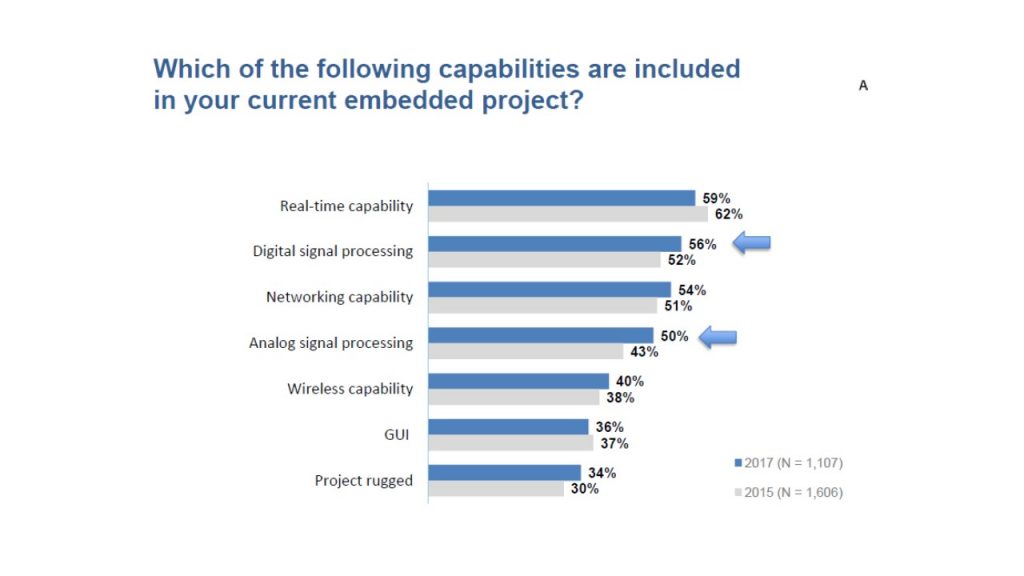
  • For the current embedded projects worked on by survey participants, the top capabilities included were real-time (59%), digital signal processing (56%), and networking (54%).

I’d be lying if I said I didn’t get a kick out of seeing that more than half the current embedded projects are using DSP!

  • The ratio of time/money spent on embedded projects was 61% devoted to software, 39% to hardware development.
  • 19% of those surveyed purchased off-the-shelf circuit boards; 81% either designed or subcontracted the design of custom circuit boards.
  • C (56%) and C++ (22%) continue to dominate as languages.
  • Debugging (23%) and meeting schedules (23%) were two big development challenges.
  • The most important factor in determining processor selection was the availability of software development tools (70%).

Lots of other information contained in the report. If you’re curious about the types of projects other embedded engineers are working on, what tools they’re using, and their everyday concerns, this survey will be a goldmine.