New Embedded Imaging Kit for Basler Dart at SPIE DCS


Critical Link’s new MitySOM-5CSx Embedded Imaging Development Kit will be on display at the SPIE Defense & Commercial Sensing show in Anaheim, April 11-13, 2017.

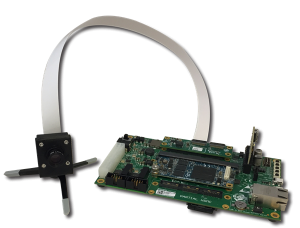
This kit pairs Critical Link’s MitySOM-5CSx Development Kit with a BCON Dart®, the latest camera series from Basler, a world leader in vision technology. This power-packed combination is the fastest path for embedded imaging application development.

SPIE DCS is the leading global sensing and imaging event, drawing attendees from commercial and defense sectors working on next generation designs in areas of robotics, test & measurement, unmanned systems, machine vision, and many others. Critical Link’s MitySOM-5CSx platform is designed for embedded applications across these areas, ensuring a faster time to market and a significantly reduced development budget. Add in integration with Basler’s dart series, the result is development platform perfectly fit for embedded vision products.

At Critical Link’s booth #219 you’ll see how a dart with BCON for LVDS  works using an edge detection application running on the MitySOM-5CSx. The demo features real-time image processing in the MitySOM’s Cyclone V SoC, using dual-core Cortex-A9 ARMs and FPGA fabric, and leveraging IP Cores from Altera’s VIP Suite. Images feed from the MitySOM-5CSx directly to a display port monitor with no PC in the loop – a key out-of-the-box feature for embedded applications.

A fully-bundled kit will be available from Critical Link in early Q2, 2017. Contact us today at info@criticallink.com to ensure earliest delivery.

View details on the MitySOM & Basler dart with BCON for LVDS demo.


About Critical Link

Syracuse, N.Y.-based Critical Link (www.criticallink.com) is an embedded systems engineering firm offering customizable system-on-modules (SOMs) and imaging platforms for industrial, medical, scientific, and defense applications. Critical Link’s end-to-end product engineering services include design, development, and production. Critical Link is a premier Partner in the ImagingHub by Basler, a Platinum Member of the Altera (Intel) Design Solutions Network, a member of the Intel IoT Solutions Alliance, and is ISO 9001:2008 Registered by SRI Quality System Registrar.


Embedded Imaging Dev Kit for Basler Dart at Automate


Critical Link’s MitySOM-5CSx Development Kit has been paired up with Basler’s latest camera series, the dart® with BCON for LVDS interface. This power-packed combination is the fastest path for embedded imaging application development, and will be on display at Basler’s booth #2666 at the Automate show in Chicago, April 3-6, 2017.

Automate is the biggest North-American show for automation, robotics, motion control, and vision. Critical Link’s MitySOM-5CSx platform is designed for embedded applications across each of these areas, ensuring a faster time to market and a significantly reduced development budget. Add integration with Basler’s dart series, the result is development platform perfectly fit for embedded vision products.

At Basler’s booth #2666 you’ll see how a dart with BCON for LVDS  works using an edge detection application running on the MitySOM-5CSx. The demo features real-time image processing in the MitySOM’s Cyclone V SoC, using dual-core Cortex A9 ARMs and FPGA fabric, and leveraging IP Cores from Altera’s VIP Suite. Image data feeds directly to a monitor with no PC in the loop – a key out-of-the-box feature for embedded developers.

A fully-bundled kit will be available from Critical Link in early Q2, 2017. Contact us today at info@criticallink.com to ensure earliest delivery.


About Critical Link

Syracuse, N.Y.-based Critical Link (www.criticallink.com) is an embedded systems engineering firm offering customizable system-on-modules (SOMs) and imaging platforms for industrial, medical, scientific, and defense applications. Critical Link’s end-to-end product engineering services include design, development, and production. Critical Link is a premier Partner in the ImagingHub by Basler, a Platinum Member of the Altera (Intel) Design Solutions Network, a member of the Intel IoT Solutions Alliance, and is ISO 9001:2008 Registered by SRI Quality System Registrar.


New Maker-Pro Kit & Embedded Vision Demo on Display at TI Tech Day Milwaukee


Critical Link’s MitySOM-335x Maker Transition Kit will be on display at the Texas Instruments Tech Day in Milwaukee, WI on March 30, 2017. Visit our table to learn more about the kit, and register to win one free.

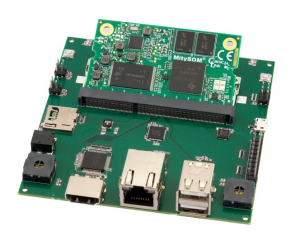
The MitySOM-335x Maker Transition Kit enables maker-pros to convert prototypes based on the BeagleBone Black with TI’s AM335x ARM processor to production-suitable designs leveraging Critical Link’s proven MitySOM-335x platform. The kit is designed to minimize changes when transitioning from the BeagleBone Black, and in many cases is a drop-in replacement. Interested developers can visit Critical Link’s engineering site to review design documentation and engage with our engineering team.

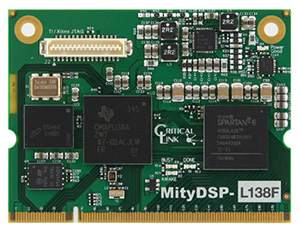
Critical Link will also be featuring an embedded vision demo using our MityDSP-L138F, a system on module based on TI’s OMAP-L138 with Spartan FPGA. Originally introduced in 2010, the MitySOM-L138F continues to be selected for new applications in unmanned systems, utilities management, networking & communication systems, factory automation, and test & measurement, among many others.

Register for free today to attend this great event!


About Critical Link

Syracuse, N.Y.-based Critical Link (www.criticallink.com) is an embedded systems engineering firm offering customizable system-on-modules (SOMs) for industrial, medical, scientific, and defense applications. Critical Link’s end-to-end product engineering services include design, development, and production. Critical Link is a Platinum Member of the Texas Instruments Design Network and is ISO 9001:2008 and ISO 14001 Registered by SRI Quality System Registrar.


Critical Link Introduces the MitySOM®-335x Maker Transition Kit

MitySOM-335x Helps Bring Maker Prototypes to Market

Critical Link is pleased to announce the MitySOM-335x Maker Transition Kit. Makers can now convert prototypes based on the BeagleBone Black with Texas Instruments AM335x ARM processor to production-suitable designs leveraging Critical Link’s proven MitySOM platform.

The Maker Transition Kit has been designed to minimize changes required for those transitioning from the BeagleBone Black, and in many cases is a drop-in replacement. Interested developers can visit Critical Link’s engineering site to review all design documentation and engage with our engineering team.

“Leading-edge designs come out of the maker community all the time, but often high potential prototypes encounter hurdles on the path to production,” says Thomas Catalino, Vice President, SOM Solutions at Critical Link. “Undocumented design changes, availability, design for manufacturability, and production costs can all derail a great product design making it to market. Our new platform helps overcome many of these challenges.”

The BeagleBone Black continues to be one of the most popular maker development platforms. It follows the community-supported model which provides numerous advantages in initial hardware costs, open source design documentation, and a large user base of talented developers willing to lend support. To take designs to market however, developers may need to step away from the community-based model and find a reliable partner to supply and support their production needs.

“Critical Link designs boards for industrial applications, meaning our customers can rely on us for long product lifespans and reliability in the field,” says Catalino. “We provide all design documentation for our base boards, and work with customers to customize designs, adding features and minimizing recurring costs as needed. Our goal is to help developers successfully launch their ideas.”

The Maker Transition Kit was introduced to select developers in late 2016, and was met with tremendous response that consumed all initial supply. General availability is projected later in Q1 2017. To order, contact the Critical Link sales team or visit https://www.criticallink.com/product/mitysom-335x-maker-transition-kit/.

About Critical Link

Syracuse, N.Y.-based Critical Link (www.criticallink.com) is an embedded systems engineering firm offering customizable system-on-modules (SOMs) for industrial, medical, scientific, and defense applications. Critical Link’s end-to-end product engineering services include design, development, and production. Critical Link is a Platinum Member of the Texas Instruments Design Network and is ISO 9001:2008 and ISO 14001 Registered by SRI Quality System Registrar.


Altera SoC Board Solution Adds OpenCL Support

Critical Link is pleased to announce support for Altera’s SDK for OpenCL on our MitySOM®-5CSx module. With this, customers now have a path to work with OpenCL in a general purpose SoC-based board, exploring the benefits of OpenCL for solving real-world problems.

OpenCL is an open framework for writing programs across an array of processing platforms. FPGA programming has proven to be a major hurdle for development teams who are inexperienced with FPGAs or are resource limited. OpenCL allows users to work with FPGAs in common programming languages such as C and C++, enabling software engineers to readily tackle this otherwise complex task.

In addition to featuring familiar language options, OpenCL allows developers to accelerate their application and drive power efficiency, providing opportunity to developers of unmanned and autonomous systems, or wherever temperature or power constraints exist.

With this Board Support Package, Critical Link is providing an off the shelf embedded platform with a first class out-of-the-box experience to help Altera customers rapidly build from source and see live examples in action. The MitySOM-5CSx module has been tested to run examples using Altera’s SDK for OpenCL integrated with version 16.0 of the Altera Quartus Prime and SoC Embedded developer’s kit.

The MitySOM-5CSx OpenCL BSP is available today as a downloadable file provided via Critical Link’s engineering support site. This site also contains instruction for use under a Linux or Windows environment. In the future, files and examples will be included on SD card images provided with MitySOM-5CSx development kits to allow users to run the examples without the need to compile them.

For customers developing imaging applications, contact Critical Link for an update on implementation of the OpenCL BSP on our MityCAM imaging development platforms.

For specifications or information on purchasing a MitySOM-5CSx module or development kit, visit https://www.criticallink.com/product/mitysom-5csx/.


About Critical Link

Syracuse, N.Y.-based Critical Link (www.criticallink.com) is an embedded systems engineering firm offering customizable system-on-modules (SOMs) for industrial, medical, scientific, and defense applications. Critical Link’s end-to-end product engineering offerings include design, development, and production services. Critical Link is a Platinum Member of the Altera Design Solutions Network and is ISO 9001:2008 and ISO 14001 Registered by SRI Quality System Registrar.


What you missed if you weren’t at ARM TechCon, Part Two

Last week, we began summarizing Rich Quinnell’s EE Times article on the new technologies that caught his eye at the recent ARM TechCon Conference. That post covered the first five of Rich’s “ten most intriguing technologies.” Here we’ll take care of the second half of the list.

Private LoRa networks arm-techcon
Multi-Tech is seeing a lot of businesses that are implementing private LoRa (Long Range wireless) networks, rather than working over public ones for their IoT and Machine-to-Machine communications. To take advantage of this:

“Multi-Tech has created a ruggedized base station that supports thousands of end nodes within an area up to 10 miles in radius, and ties that local cell into the wide area network. This architecture allows users to create private LoRa networks within, say, a building or a corporate campus, then tie those networks together through the cloud. The result is the ability to deploy and manage a large number of IoT devices that are geographically diverse, in a private network.

More news: the LoRa Alliance may be “working on a roaming strategy for [its] wireless standard that will allow devices to switch from private to public networks and back again, and among carriers. Sounds interesting. (We’ll be staying tuned.)

Modular design prototyping system
ProDesign Electronic is offering its ProFPGA prototyping system. This will let developers build SoC prototypes that will enable them to test system software even before the silicon’s available. There will be multiple baseboard options (one-, two-, and four-slot)

“…into which they can plug any of several FPGA modules to build up their design. The modules can then connect together to share high-speed signals, as can up to five baseboards, to build up the resources needed to prototype a full design. Each FPGA module can also accept several of 60 different IO modules to handle this functionality without consuming FPGA resources.

This should make for faster prototyping than using a simulation.

Sensor-based IoT
Would developers be “inspired” to create sensor-based IoT devices if it were made simpler? Silicon Labs apparently thinks so. They’re introducing the Thunderboard React kit.

“In addition to the demo software, which works right out of the box, ‘the kit makes all the mobile app, cloud service, and device code available to developers’.”

The board is based on a Silicon Lab’s own Bluetooth Smart radio module, “and a collection of the company’s sensors to provide both a demonstration platform and a prototyping vehicle.”

Ultrasound creates tangible virtual objects
Apparently it wasn’t demo’d on the conference show floor, but Ultrahaptics had an offsite demo of its virtual object creation system.

“This innovative technology uses a phased array of standard ultrasonic rangefinders to create pressure at up to four arbitrary points within a conical volume above the array. By refreshing the points’ locations at speeds to 20 kHz, the array can create the illusion of a physical object in mid-air. The sensation is light (like a soap bubble bursting) but quite noticeable. The aim is give gesture control systems a physical presence to help guide user interaction. Knobs, buttons, sliders, and the like are readily created using the array, as are a variety of surface textures.

A development kit for those interested will be available after the first of the year.

The Zephyr Project aims to bring real-time to the IoT
Last but not least on Rich’s list is the Zephyr Project, an RTOS for IoT device developers.

“This open-source, community-created code is available through the Linux Foundation under the permissive Apache 2.0 license to make it as uncomplicated to use and deploy as possible. “

The aim? “’To be the Linux of microcontrollers.’”

Sounds like ARM TechCon was, as always, plenty interesting. Thanks again to Rich for sharing his findings and insights.


What you missed if you weren’t at ARM TechCon

arm-techconWe weren’t at the recent ARM TechCon, but are always interested in hearing about what’s new that’s ARM related. So we were very interested in Rich Quinnell’s account (on EE Times) on the ten most intriguing technologies that he saw on display there. Here’s part one of my quick summary of Rich’s article:

Ada development for the IoT
AdaCore, which has been primarily focused on aerospace and defense, is now making a move into automotive, and the Internet of Things (IoT). Ada’s strengths are in its testing, quality assurance, porting, and functionality upgrading capabilities. “Because Ada tools verify software while it is being developed, Ada projects tend to be those where software quality and reliability are paramount.” In light of security concerns around the IoT, made more pronounced y the recent major DNS event, the fact that Ada helps developers avoid the sorts of software vulnerabilities that may hamper security, it should play well for IoT apps.

Low-impact location
Comtech Telecommunications is bringing out the IoT Location Platform, which offers location info without requiring a GPS or external beacon.

“Rather than performing the location calculations on the device…a 2kB software agent simply captures information from the device’s wireless links, such as signal strength and server ID codes, and sends a short (~200 byte) message to Comtech servers, which perform the calculation needed to turn that information into a location fix. From there Comtech can provide a variety of location-based services to IoT device users, including real-time mapping of device locations.”

Resistive RAM
Crossbar has something that it calls resistive RAM (RRAM).

“The RRAM cell is a vertical resistive layer of amorphous silicon between two metal pads. The device stores data by imposing a voltage across that layer to create controlled growth of a conductive “filament” through it. The filament does not fully short between the metal layers, however, which allows the process to be reversed to eliminate the filament.”

RRAM is fast, “a considerable advantage over traditional Flash in terms of access times as well as providing energy savings by eliminating the need to block erase in order to alter a memory location.”

Managing IoT devices
Device Pilot won ARM TechCon’s Best Software Product award this year, with a SaaS offering that automates management of IoT devices. It monitors the data stream coming from the devices, and sends out an alert and/or takes remedial action if something seems “off” – like there’s no data being sent. Automating the management of IoT devices will become increasingly important as these devices proliferate.

Reducing SoC design risks
FlexLogix is primarily interested in licensing its IP cores, rather than focus on chips. So it’s built test chips that let developers prove out their designs in silicon. With their approach, FlexLogix is looking:

“… to enable SoC designers to add FPGA flexibility into their designs to help future-proof them and to reduce risk by making critical interfaces configurable to allow for changes in specifications or standards.”

Alongside the silicon technology it offers, FlexLogix also provides tools “that help simplify the design-in of the FPGAs.”

We’ll cover the next five technologies in next week’s post.

Meanwhile, a Critical Link hats off to Rich Quinnell. Reading your report on the show was the next best thing to being there.

ARM in Space

Like most “science kids”, I grew up interested in rockets and space exploration. I haven’t completely outgrown it – does anyone ever? – so it was not surprising that a recent blog on EDN by Rajan Bedi, Spacecraft data handling using ARM-based processors, caught my eye. (Bedi is the CEO of a consulting company called Spacechips, which focused on space electronics. Is Spacechips a great name or what?)

Bedi writes that, at some space industry FPGA conferences he had attended this year, there was much discussion about “the need for a small, low-power, high performing MCU to replace larger, more dissipative FPGAs. For localized control and processing, such as sensor TT&C [telemetry, tracking, and command] or digital control of a voltage regulator, a dedicated MCU would offer a more efficient CPU/DSP option.”

He then suggests that the answer may be close at hand, given that ARM-based chips are so ubiquitous today. How ubiquitous? Try 90 billion of them, in our phones, tablets, cars, wearables, and IoT devices. That’s ubiquity.

The ubiquitous ARM architecture offers small, low-power, high-performance cores, many of which are being used in safety-critical applications, such as car braking systems, power steering, self-driving vehicles, aircraft, medical, railway and industrial control sub-systems, conforming to fail-safe standards.

Bedi points to the proven reliability of ARM-based systems, and asks:

“…could the space industry also benefit from the performance, power, size, ease of use, and accessibility benefits of the ARM architecture? There is a huge, tried and tested ecosystem spacex_crs-10_patchavailable to enable developers to build reliable control and DSP embedded applications.”

After mentioning a few commercially available space-grade options, he goes into a full description of the use of an ARM processor to handle localized control and processing functions. Okay, it’s pretty much a free ad for Vorago’s VA 10820, a “radiation hardened ARM Cortex – M0 MCU”, but that doesn’t take much if anything away from the overall write-up. This radiation-hardened technology, by the way, will soon be getting a space shot. It’s deployed “on the Vorago’s radiation-hardened technology will soon be getting a space shot. It’s deployed “on the STP-H5 payload to be launched by SpaceX and further parts will enter orbit next year on a GEO mission as well as a LEO spacecraft.”

If you’re one of those “science kids” who grew up interested in rockets and space exploration, and went on to become an electronics engineer, you should definitely read the entire post.

Critical Link Partners with Gumstix® for Online Design-to-Order Service


BoardGeppetto® D2O Custom Expansion Boards Available for MitySOM®-335x


Gumstix®, Inc., the leader in design-to-order embedded systems, today announced a partnership with Critical Link, LLC to provide support for Critical Link MitySOM-335x COMs in Geppetto® Design-to-Order (D2O) platform created by Gumstix engineers. Using Geppetto D2O, customers can rapidly design and manufacture small form-factor boards custom tailored for industrial applications that require the versatility of the MitySOM®-335x powered by the Texas Instruments Sitara™ AM335x family of processors.

Critical Link specializes in building both affordable and powerful system-on-modules (SOMs), also known as COMs, for scientific and industrial applications. With the inclusion of the Geppetto D2O MitySOM-335x Connector and Gumstix  MitySOM-335x development board into the Geppetto D2O platform, Critical Link customers now have two paths to create custom expansion boards to actualize the audio, visual, networking and robotic potential of the MitySOM-335x.

“In today’s world, the ability to get to market faster than the competition can make or break the success of a product,” says Tom Catalino, Vice President of Sales and founding Partner at Critical Link. “Our SOMs have been helping customers accelerate their time to market while cutting development costs for over a decade, and now the Gumstix partnership puts Geppetto D2O, a simple and powerful online design tool, in the hands of our customers, further maximizing their potential for success.”

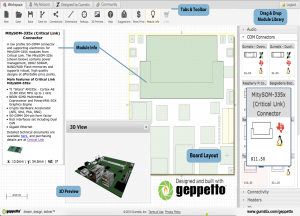
Geppetto_design_screen

Using Geppetto D2O within their browser, customers can clone and drop the Gumstix  MitySOM-335x dev board into the Geppetto D2O workspace to jumpstart their design or custom build an expansion board for the MitySOM-335x from scratch utilizing the simple drag and drop interface. The Gumstix  MitySOM-335x expansion board is especially suited for video and audio applications incorporating an audio codec for left and right speakers, an HDMI port for audio and visual displays and SPI, UART, I2C  and 20-pin Male headers.

“Critical Link customers can now evaluate development boards from Gumstix that are also available for rapid customization in Geppetto.” says Gordon Kruberg, Gumstix CEO,  “Geppetto provides them a path to manufacturing the embedded product in one online order, deliverable in three weeks.”

Once customers are satisfied with their expansion board designs in Geppetto D2O, engineers at Gumstix will test and validate the board design, manufacture and ship the production ready board 15 days from order; reducing both the production and development time for the customer. All Gumstix products and quantity discounts are available at www.gumstix.com.


About Gumstix, Inc.

As a global leader in design-to-order hardware and manufacturing solutions, Gumstix® gives its customers the power to solve their electronic design challenges with Geppetto® D2O — the online design-to-order system– and a broad portfolio of small computers and embedded boards. In addition to engineers and industrial designers, Gumstix helps students, educators, and makers unlock their creative ideas to bring them to market. Since pioneering the concept of an extremely small computer-on-module (COM) with a full implementation of Linux in 2003, the company has grown to support over 20,000 diverse customers. Our systems have launched some of the world’s coolest products – from phones to drones – on commercial, university, and hobbyist workbenches in over 45 countries. For more information, visit www.gumstix.com


About Critical Link

Syracuse, N.Y.-based Critical Link (www.criticallink.com) is an embedded systems engineering firm, offering a broad range of highly customizable, small form factor system-on-modules (SOMs) for highly integrated, embedded systems for industrial, medical, scientific, and defense applications. Critical Link’s end-to-end product engineering offerings include design, development, and production services. Critical Link is a Platinum Member of the Texas Instruments Design Network and is ISO 9001:2008 and ISO 14001 Registered by SRI Quality System Registrar.


About the Texas Instruments Design Network

Gumstix, Inc. and Critical Link are members of the TI Design Network, a premier group of independent, well-established companies that offer products and system-level design and manufacturing services complementing TI’s semiconductors to a worldwide customer base to accelerate product innovation and time-to-market. Network members provide product design, hardware and software system integration, turnkey product design, RF and processor system modules, reference platforms, software development, proof-of-concept design, feasibility studies, research, certification compliance, prototyping, manufacturing, and product life cycle management. For more information about the TI Design Network, please visit http://www.ti.com/designnetwork.
 

The three embedded market trends you should be considering

Last week, we posted an article on the ARM Connected Community site. This is an interesting and useful information-sharing forum for anyone working with – or just plain interested in – ARM. There are a number of “subdivisions” dedicated to specific areas, from ARM processors to SOC to wearables.

Our post wasn’t ARM-specific, but was rather our take on the trends we’re seeing in the embedded market (including ARM, of course). Anyway, I thought you’d be interested in what we had to say, so we’re running the article here, as well.

EmbeddedMarketTrendsWe at Critical Link have worked on some pretty complex applications for nearly 20 years, and so we’re exposed in real time to trends in the embedded market. Our work creating System-on-Modules (SoMs), custom baseboards, and complete ground-up solutions for various markets has helped illuminate three key trends we think are transforming the embedded computing market.

First is the increasing demand for an engaging user interface. Traditionally, the higher end the application, the less focus on the UI. Blue, green, or amber screen, seven segment or text display, command line or simple menu picks – all were fine. But now that everyone has gotten used to what’s possible with cellular telephone interfaces and apps, customers are demanding an improved user experience in other applications.

Whether they’re building something new from scratch or refreshing an existing product with a sexier display, embedded developers are paying a lot of attention to the interface. They are looking at options for integrating a color LCD display and Ethernet or WiFi capability. So although a product itself may not require an ARM core, the final architecture will require an ARM-based solution that runs embedded Linux because it enables the desired UI improvements and connectivity.

A second important trend for embedded designers is the combination of rising technology complexity and the rate of integration. At Critical Link, our products have focused on combining FPGAs with either DSPs or ARM technologies. Traditionally these have been discrete solutions with the device connectivity at the board level. But with the new System on Chip (SoC) architectures where the FPGA and ARM are contained in the same die, companies often don’t have the experience to get these two technologies to work together efficiently and effectively. The software team doesn’t always understand the FPGA, and the hardware developers struggle with software in the ARM. Neither can do without the other, and as a result talented engineers who are proficient in both disciplines are in high demand. (Given that many of our customers don’t have those resources available, our approach has been to provide examples and a full setup to help customers get over their learning curve.)

In conjunction with this comes the third key trend: We continue to see companies narrowing focus to their true core competencies. They see value in leveraging off-the-shelf boards and focus on their unique expertise and developing the domain specific performance that distinguishes the product from competitors. In fact, we’ve seen a drastic shift away from the belief that making it all in house saves money. To do more with a smaller engineering team, companies who would never consider working with off-the-shelf hardware are now recognizing it as a key piece of their get-to-market strategy, and ultimately faster ROI.

Even after 20 years, we continue to be on the lookout for what’s next, but for now these are some of the trends we’re seeing unfold in real time, each of which are likely to continue driving innovation in the embedded market.