
As we wind down 2022, and look ahead to 2023, the Critical Link family would like to wish you all the happiest of holiday seasons, and a healthy and prosperous new year – one filled with interesting work and exciting technology in the dynamic industry we all call home.
Category Archives: Blog
All I Want for Christmas…

Most years, as we enter the height of the holiday gift-giving season, I take a look around to see what’s interesting when it comes to tech-toys for kids (which I posted on a couple of weeks back). And, of course, what’s interesting when it comes to tech-toys for grownups. Because if there’s one thing most techies like, no matter what their age, it’s a tech toy.
But this year, there’s one tech toy that stands out, that hovers over the tech toy landscape. And that’s the XTurismo.
So all I can say is, all I want for Christmas is a flying bike.
A flying bike…
Sure, when I was a kid, I dreamed about flying around my neighborhood powered by nothing more than my Superman cape. But hopping on my flying bike was right up there, as well.
How fun it would have been to fly over the houses and backyards of all my friends, the park where we played ball, the schoolyard, our church, the grocery store, McDonald’s. There was something about it that always captured my imagination.
The XTURISMO, which is produced by Aerwins Technology, a Japanese company, was introduced at the Detroit Auto Show in September – in plenty of time for the holidays. Admittedly, it’s hovering more than it is flying, and is pretty much billed as a hoverbike. But I’m not going to split hairs here. To me, it’s a flying bike, and it’s the stuff of dreams:
While the hoverbike’s center indeed looks like a street bike, it’s surrounded by large fans, lending the vehicle the overall appearance of a massive, rideable drone. The 300-kilogram (661-pound) hoverbike is powered by both an internal combustion engine and a battery, which together lend XTURISMO its 40-
kilometer (24.8-mile) cruising range. XTURISMO can zip around at speeds up to 100 kilometers (62 miles) per hour while carrying payloads (AKA drivers) up to 100 kilograms, or 220 pounds. (Source: Extreme Tech)
The XTURISMO is loaded with plenty of tech:
Riders are kept safe with its 3D control systems, air-route designs, mapping controls, and added sensors to detect any hurdles in the air. Using its dedicated app, riders are also afforded a virtual dashboard and localization, so that they are always informed on the flying motorcycle’s health and position. (Source: Design Boom)
There are a couple of downsides. The XTURISMO is apparently as noisy as a leaf-blower. And then there’s the price tag. It’s available for – gulp! – $777,000. Aerwins is anticipating that there’ll be a scaled down all-electric version available in the U.S. for $50K in a few years time.
There’s also the issue of whether the XTURISMO is considered an aircraft or not. In Japan, it’s not considered a flying machine, and there’s no special license required. You just hop on your XTURISMO and take off. It’s considered the same as riding a bicycle. This isn’t likely to be the case in the States in the long run.
Even in Japan, even if the price point were more accessible, it’s not as if the friendly skies are going to be crowded with hover bikers. While there are no special licensing requirements, riders can only fly over racetracks. (By the way, Aerwins are only planning on making 200 XTURISMOs, so this will definitely be a very limited, very luxury, very niche item.)
When it comes to flying bikes, the XTURISMO isn’t the only game in town.
While it hasn’t gotten the press and hype that the XTURISMO got from its announcement at the Detroit Auto Show, there’s a fellow in Newton Falls, Ohio, who claims to have invented the first ever electric flying bike. The Flypod E-Bike which, at $15-17K, is lightweight and a bit more affordable than the XTURISMO. Somewhat scarily, you don’t need a driver’s or a pilot’s license and there’s no age limit. So a kid – me at the age of 11, I guess – can flypod their way to happiness.
Here’s what the inventor has to say:
“There is nothing like that feeling when you break free from the ground,” says Kurt Fister. “You feel yourself leaving Earth and it’s the most incredible feeling of freedom you could ever have…My youngest student is 11, my oldest is 92,” Fister said. “With this aircraft because of its weight, size and it’s so small, they can now have the dream of flight for the cost of a motorcycle and they can experience it despite anything that might be an FAA handicap.” (Source: WFMJ)
The Flypod E-Bike is really closer to my childhood conception of a flying bike. It only requires a “runway” of 30-40 feet, and can land on less than that. So it’ll work out of the backyard. I don’t know about what built-in safety controls it has in place. At its price point, I don’t imagine it’s as teched up as the XTURISMO. (You do get what you pay for.)
I guess my bottom line is that, even if my three kids chip in for a consolidated gift for dad, I don’t expect to see an XTURISMO or a Flypod E-Bike under my tree.
Which is too bad, because, when I think about it, all I want for Christmas is a flying bike.
What to get the kids this holiday? Here are some suggestions.

If you’re a plan ahead sort of person, you may have your holiday shopping all done.
If not, and you’re looking around for gifts on the techie side of the toy aisle, I found a few suggestions for you.
One list I saw was on Wired. There was nothing on their list that’s actually a toy, but kids today are part of the digitized world from a very young age. The digital devices Wired suggests might be of interest if you have kids in the pre-smartphone cohort. I’ll pull some of them out for you, but the full list is worth a full read through. (The writer who pulled together this collection, Adrienne So, has children who are 5 and 7 years old, and the reasoning for her choices is both thoughtful and informed by her real-life experience.)
Belkin makes child-sized headphones (the Soundform Mini) in a range of colors – and you can limit the volume and product your kids’ ears. Higher up in price range, So likes the Amazon Fire HD 8 Kids edition, which she finds durable and of good value if you’re willing to limit your kids to the proprietary content find on Amazon Kids+ (which has plenty of books, apps, music, games…)
The PlayShifu Tacto Chess game is kind of cool. “It turns the surface of the iPad into a game board and uses physical pieces to teach your kids moves and strategy.” Fun, but nothing you can’t do the old-fashioned way, i.e., play chess on a physical chessboard.
I mentioned that nothing on Wired’s list was actually a toy. But here’s one item that you wouldn’t even wrap up and give to your kid: the Jiobit Smart Tag location monitor. Not that I couldn’t have used this a few times when my kids were little, but it’s really a sign of the times – and not in all that wonderful a way – that parents feel the need to use an app to check on their kids once they’re outside playing.
Back in the more fun zone, there’s the Amazon Echo Dot Kids speaker, which come in very cute animal designs. In addition to playing music, there’s an Alexa skill (i.e., an app), the Reading Sidekick, that helps novice readers learn to read. And speaking of reading, there’s the Kindle Paperwhite Kids Edition, which lets your kids feel all sorts of techie without getting them hooked on being on the Internet.
Too late for Halloween, but if your kids are waiting for the bus when it’s still dark out, or out riding their bike at dusk, So likes the Knog Plus clipon lights. Another item more for the parents than the kids.
The final tech gift on So’s list is the Nintendo Swtih Lite. I like what she says about an advantage of this console: “The best part about getting a Switch for your kids is that even if they lose interest, you can play on it yourself.”
Engadget’s tech gift/toy list by Kris Naudus is more on the fun, toyish side. It includes the Leap Frog Chat and Count Emoji phone, ideal for the pre-pre-pre-smartphone set. It includes a number of skill-building minigames, and will help keep your little one’s hands off your iPhone.
Who doesn’t like drones? Well, plenty of people, but I’m not one of them. But if the idea of having your child playing with a full-fledged drone, the Air Hogs Gravitor “is a different kind of drone, one they can control with a wave of their hand.” Better yet, it’s designed with soft edges to minimize the prospect of injuries.
Meanwhile, a Hello Kitty Purse Pet just blinks and makes noises, so it can’t do anyone much harm. Another way to make noise is with the Yoto Mini Player, a speaker that provides entertainment and diversion – audiobooks, songs, podcasts – without having your kid’s eyes glued to a screen.
There are a couple of Lego kits on the Engadget list. One is the LEGO NASA Apollo Saturn V kit, which is more toy than tech. Be warned: this is a sophisticated “toy” for older kids and adults.
My favorite item on either list is the LEGO Motorized Lighthouse set. This is pretty pricey – around $300 (there are less detailed versions for less), but it combines the old-fashioned fun of building something, with something for the more science-technically oriented kids. “The best part has to be the working fresnel lens at the very top of the lighthouse, just like the real thing but smaller — it can rotate thanks to the motor (which you’ll also put together).” Sounds like my kind of tech toy!
Happy shopping!
EE Times turns 50 – Hall of Fame Part 2

As part of EE Time’s 50th anniversary celebration, they’ve created a virtual “Hall of Fame” for engineers “who have helped make the industry safer and cleaner!” In my last post, I wrote about two of the Hall of Famers, Ed Sawicki and Neal Langerman. This week, I’ll round things out with a post on Braden Allenby and Mousumi Bhat.
Chlorofluorocarbons (CFCs) were once used in a broad range of applications, many in the electronics industry which “relied intimately on CFCs for cleaning every electrical connection at every step of the manufacturing process.” While at one point it was thought that CFCs evaporated and miraculously disappeared once they were done with them, that turned out not to be the case. They were up in the stratosphere, boring a hole in the ozone layer. If the hole kept growing, we’d be facing all sorts of environmental devastation, wreaking havoc on human health in all sorts of ways and damaging crops as well.
Unfortunately, when it came to the electronics industry, “no one had any idea how to make chips or circuit boards without them.”
Enter Braden Allenby.
While working as an attorney for AT&T, Allenby began pursuing a PhD in environmental science in his free time. His dissertation, completed in 1992, ended up helping to bring about a sea change in the way our industry took the CFC problem on.
Companies had typically treated environmental considerations as an afterthought, relegating corrective action to “end of pipe” solutions — that is, trying to mitigate problems such as emissions and toxic chemicals after they were produced. “Executives saw environmental concerns as overhead,” said Allenby. “They didn’t think about them during planning and production. If you ended up with a bunch of barrels of toxic chemicals, then you got rid of the barrels. If you made the air or water dirty, then you tried to clean it up. There was no systemic approach to protecting the environment.”
In his dissertation, Allenby argued for the much-needed ‘systemic approach’ – one that took environmental considerations into account throughout the development and manufacturing process, rather than waiting to solve a problem at the “end of the pipe.” Further, Allenby promoted the idea that taking care of the environment was a key strategic issue, not just a cost issue.
From his position at AT&T, Allenby was able to make sure that his dissertation didn’t just sit on the shelf. He worked on creating a collaborative process, in which AT&T joined up with both competitors and the EPA to help resolve environmental problems. The organization that Allenby was a catalyst for, the Industry Cooperative for Ozone Layer Protection (ICOLP) worked.
Within a few years, ICOLP had produced a range of techniques and identified a number of CFC alternatives that filled the bill in different electronics manufacturing applications, at different stages of the process, and with different types of materials. Those solutions were not only freely shared with all of the industry, including companies that had nothing to do with ICOLP, but they were distributed to other industries and governments around the world.
Further, ICOLP took on the industry’s lead solder problem.
While some lead solder is still used today, the group helped develop a way to use nitrogen gas that allowed lead alternatives such as bismuth and silver to work in many soldering applications.
Today, thanks in large part to Allenby’s efforts, the industry understands the role they must play in cooperatively stepping up to solve environmental challenges.
Nearly twenty years ago, it was a question from her 7-year-old daughter, which prompted Bhat to start focusing on greenhouse gases. While they were planting a tree, her daughter – I’m guessing a scientist in the making – asked “why no one had invented an artificial version of photosynthesis, the process by which plants turn sunlight into energy while capturing carbon dioxide.” This got Bhat thinking, and, as she was then working as an R&D manager at Motorola, her thinking honed in on the semiconductor industry, and ways to make it run more sustainably.
[Bhat’s] curiosity would lead to a long quest to actually do something to advance greener chipmaking. She was somewhat ahead of her time at the start, because few major companies in 2004 saw decarbonizing as a high-priority goal. But over time, the semiconductor industry, not to mention the rest of the world, has come to share her sense of urgency. And earlier this year, Bhat was finally put in the right position to do something about it when SEMI, the organization representing the global semiconductor supply chain, named Bhat vice president of sustainability.
In this role, Bhat is taking on an ambitious sustainable mission to cut down on the greenhouse gases the industry generates.
The semiconductor industry has a bigger carbon emissions problem than many realize, and it’s a problem that’s about to get much bigger. The trouble is rooted in the industry’s success, Bhat noted. An annual growth rate of about 10% has led to a worldwide boom in fab expansion and construction, with more than 80 new fabs scheduled to come online by 2025. The explosion in chipmaking volume is inevitably leading to a parallel blow-up in industry carbon emissions. “Our industry’s carbon footprint makes up about 1% of the world’s footprint today,” Bhat explained. “But soon, it will be about 12%. At this rate, by 2030, we’re going to be more than a factor of 2 behind where we’ve committed to be in our emissions-reduction goals.”
Bhat is focusing on three different arenas, or “scopes.” Scope 1 concerns the emissions that a company is directly responsible for. In the semiconductor industry, these come from the gases (perfluorocarbons and sulfur hexafluoride) used in chip making. Scope 2 emissions come from the tremendous amount of energy the semiconductor industry requires for heating and cooling along its entire manufacturing process.
Even after years of work, improvements have been incremental, and cost-effective technologies remain somewhat elusive.
Those two classes of emissions can in theory be addressed through the use of alternative gases and manufacturing processes. But a more complex challenge is presented by Scope 3 emissions, which are those created throughout the supply chain for chips and other electronic components, as well as through the downstream use of the industry’s products.
SEMI has just launched a new initiative, the Semiconductor Climate Consortium, to focus on the three scopes, and accelerate the process of implementing change. It will also focus on end-consumer “awareness of the advantages of reducing waste from discarded products and to facilitate the availability of more products that are repairable, upgradeable, and recyclable. “We need a lot of activity around creating circularity in product life cycles,” said Bhat.
Interesting that Bhat’s new job was the end result of a question her daughter asked her nearly twenty years ago.
Meanwhile, congratulations to all four Hall of Fame engineers, and to David Freedman for his series introducing me to these pioneers. Lots of work still to be done, but it’s gratifying to see that so much has already been accomplished.
EE Times turns 50: The “safer and cleaner” industry Hall of Fame – Part 1
This year, EE Times turns 50, and to celebrate the occasion, they’re publishing a lot of interesting content on the history of the electronics industry. One thing they’ve done is a series of articles by David Freedman that call out the work of some of the “Hall of Fame” engineers “who have helped make the industry safer and cleaner.”
Here’s a bit about two of the engineers – we’ll get to the others in a later post – they’ve elected to their virtual engineering version of Cooperstown:
The Father of Semiconductor Safety
In the early 1970’s, Ed Sawicki, having just returned from a tour of duty in Vietnam, was going to school to study engineering and working part time. One of his gigs was working security for Signetics, a pioneering chipmaker. Soon, safety was added to his mission. Here, his wartime experience with demolition stood him in good stead.
The list of chemicals used in the early days of chipmaking was a who’s who of volatility and potential
 toxicity, including arsine, silane, lead, arsenic, hydrochloric acid, and benzene. “Silane is 9× as explosive as TNT by weight,” Sawicki points out. “These were nasty chemicals, and the industry had some hellacious accidents.”
The EPA and OSHA had recently been created, so environmental and workplace issues were capturing some attention. While Sawicki saw the need to address safety issues, he wasn’t in any position – little authority, no budget – to put in place the precautions he thought were essential. Then he heard that a new kid on the block – Intel – was hiring. They were in need of a safety engineer. And they were committed to making real improvements in semiconductor manufacturing.
Because everything was new, Sawicki was creating the Intel safety model from scratch.
He brought in scientists, engineers, and physicians from Harvard University and other top institutions who specialized in analyzing toxic and volatile chemicals and their impact on humans, often applying lessons learned in the mining industry. He didn’t know it, but he was helping to grow the nascent field of what would become known as “industrial hygiene,” which applied science to improving health and safety in industry.
Among the changes Sawicki put in place, he brought in infrared spectrometers to detect whether there were any toxic gases leaking. Without this early warning system, the only way companies knew there was a leak was when their employees started getting sick. He also set up an in-house HAZMAT team which, after a while, local fire departments started enlisting for help with incidents at other companies. Intel came up with a new position for Sawicki: global director health and safety.
In 1979, Sawicki left Intel to become a consultant. Over the years, he worked with most of the big semiconductor outfits, as well as with a number of Silicon Valley fire departments. He also helped found two industry-wide associations so that firms could collaborate on health and safety issues, and worked on international safety policies for electronics manufacture.
The National Institute for Occupational Safety & Health dubbed Ed Sawicki “the father of semiconductor safety.” Of this Sawicki says, “There’s nothing left on my bucket list.”
I’d say that’s a pretty good legacy.
The Gospel of Semiconductor Safety, according to Neal Langerman
Right on Ed Sawicki’s heels, and sometimes running in parallel, Neal Langerman, a Utah State University chemistry professor, got involved in chemical-safety training at a major semiconductor plant. Recognizing that “every fab [was left] to deal with safety in a disorganized, ad hoc way,” he set up a company that began focusing on semiconductor industry safety.
There was the silane gas problem. And the phosphorous oxychloride was used in some fabs, “which, if leaked, decomposes to a skin- and lung-burning mist of phosphoric and hydrochloric acid.” Some processes resulted in the production of deadly phosgene gas. The world’s consciousness – and the consciousness of the semiconductor industry – about gas leaks was raised in 1984 when a leak at an insecticide plant in Bhopal, India killed 2,000 people within hours. Over time, 15,000 deaths were attributed to the Bhopal leak, and hundreds of thousands suffered ongoing health problems because of it.
There were human safety issues to consider – and they were paramount – but the shutdown/restart costs to recover from a leak could also be colossal.
Langerman became “a persistent advocate for standardizing industry-wide chemical-hazard prevention and response practices.” His work got an assist from the introduction of “technology that could pick up even trace amounts of chipmaking chemicals.” (Prior to the early 1980s, the techniques available weren’t sensitive enough to detect chipmaking chemicals.) Other breakthroughs included the development of chemicals to neutralize leaked toxins, and improved equipment for moving those toxic chemicals around.
These weren’t Langerman’s inventions, but he helped developed processes and policies for the industry, “push[ing] the gospel of formalizing and standardizing safety practices.”
No word on whether these two Hall of Famers ever crossed paths, but I’m betting they did. These days, we can pretty much take many of the safety fundamentals in our industry for granted, and we have Ed Sawicki and Neal Braverman to thank for that.
Halloween: yet another area where technology has made inroads

I am continually amazed by the inroads technology has made into all aspects of our lives. As someone who remembers rolling down a car window, and using a phone that – however long the cord – was tethered to the kitchen wall, I’ve certainly seen a lot of these inroads in my lifetime.
Halloween is one area where technology has definitely encroached, and much of that encroachment has occurred when it comes to decorations.
When I was a kid, Halloween decorating was pretty low key. A carved pumpkin on the doorstep. A scarecrow propped up on the front lawn. Maybe a plastic skeleton hanging in the window.
Halloween décor became more of a “thing” when my now-grown kids were little, but it was still not that big a deal.
Now, of course, electronics have taken over. ZDNet even has a recommended list of animatronics, robots that can put you in the Halloween frame of mind and/or scare the trick-or-treaters who come by your house.
ZDNet gave the best overall Halloween animatronic nod to Wally the Clown. Fear of clowns is pretty widespread. (I’ve seen figures ranging from 10% to 40% of all Americans. I’m guessing that the 40% would include those who, while they may not fear clowns, loathe them.) There’s no clowning around here. Wally is 6 feet tall, his body moves, and he has a repertoire of four scary phrases:
- “Hey, you look familiar. Maybe because I’ve been hiding under your bed!”
- “That’s it, come closer. I’ve got something for you, and it’s not a balloon!”
- “Oh, did I scare you? Good. You taste much better when you’re scared.”
- “Good, run away. I’ll catch up with you later in your nightmares!”
This might be a little too creepy for little ones. Hopefully Wally will only act up/act out for older kids. And grownups.
When I was a kid, a scarecrow was an inert “character”: old clothes stuffed with rags, propped up against a tree or sitting in a porch chair. Not really all that scary. But the animatronic Sitting Scarecrow – ZDNet’s #1 for best porch item – is plenty scary. It “looks up quickly and cackles when someone reaches into the [candy] bowl.” Props to the kids wiling to grab a treat from that bowl.
Then there’s the Gargoyle Skull Candelabra, a not particularly scary indoor decoration. It does float around, flickering and making spooky sounds as it goes. It deploys old school “bump and go” technology, so that when it runs into a wall it starts moving in another direction. I wouldn’t recommend this one if you’ve got pets.
ZDNet also likes the life-sized animatronic Talking Witch. She’s not all that scary looking – nowhere near as scary as Wally the Clown – and her phrases – “Eeeheheehe, beware!”…”You’re not really scared, are you?”…”I would go back if I were you!” – are pretty tame compared to Wally’s. But her voice is creepy.
Not that I’m going to run out and get one, but I liked the animatronic Fortune Teller. It’s a lot smaller than Wally or the Witch, and she gives out funny fortunes such as “My advice to you is… if you’re too open-minded, your brain may fall out!”
I might consider playing around with adding some creepy sounds to my doorbell, but I’ll be steering clear of the pricey animatronics. Mostly, I think I’ll stick with just figuring out what sorts of candy to give out, and how many pieces I need (making sure the amount includes plenty of leftovers for snacking). No technology needed there!
The Internet of Plants and Trees

There’s a lot going in the world of technology focused on plant life, and I’ve recently seen a few stories about plant tech that captured my interest
Wearables for plants:
We’re all familiar with wearable devices. In fact, there’s a pretty solid chance that, if you’re reading this post, you’re wearing one now.
There are even wearables for plants.
I’m not sure that there are many folks who’ll be putting sensors on the philodendron in their living room, but if you’re a farmer, own a greenhouse, or are a serious gardener, it might be nice to know when your crops and plants need watering. I wasn’t familiar with them, but electrodes to monitor for drought stress have been around for a while. But earlier ones were difficult to keep attached. So researchers played around with two different types of electrodes:
…one made of nickel deposited in a narrow, squiggly pattern, and the other cut from partially burnt paper that was coated with a waxy film. When the team affixed both electrodes to detached soybean leaves with clear adhesive tape, the nickel-based electrodes performed better, producing larger signals as the leaves dried out. The metal ones also adhered more strongly in the wind, which was likely because the thin squiggly design of the metallic film allowed more of the tape to connect with the leaf surface.
Next, the researchers created a plant-wearable device with the metal electrodes and attached it to a living plant in a greenhouse. The device wirelessly shared data to a smartphone app and website, and a simple, fast machine learning technique successfully converted these data to the percent of water content lost. (Source: Printed Electronics World)
Monitoring water content doesn’t just help address the drought issue. The data derived from water content also provides info on pest exposure and toxicity levels.
Next up for these researchers: making sure the devices work in the great outdoors.
Taking Inventory of the Forest
Purdue is already using technology outdoors. Researchers there – digital forestry researchers – are deploying mobile mapping sensors and systems to do tree counts and measurements in forests. Beyond just doing tree headcounts, researchers foresee that the technology they’re developing will help “prevent forest fires, detect disease, [and] perform accurate carbon counting.”
The technology uses manned aircraft, unmanned drones and backpack-mounted systems. The systems integrate cameras with light detection and ranging units, or LiDAR, together with navigation sensors, including integrated global navigation satellite systems (GNSS) and inertial navigation systems (INS). (Source: Purdue)
And the technology can inventory more than a thousand trees in just a few hours.
If a tree tweets in the forest…
My favorite story was one a friend in Boston saw on local news last month. It seems that there’s an old oak in a forest in central Massachusetts that tweets. This tree, one of a growing number of “witness trees” that monitor and report on their health, is wired with a number of sensors:
The tree has a sap flow sensor to measure how much liquid is flowing up and down the tree. There is a growth sensor that is monitoring the tree in real time. There is a camera constantly taking pictures to measure the leaf canopy. All of this data feeds into code, powering the Witness Tree’s tweets. (Source: CBS News – Boston)
@awitness tree is part of the Harvard Forest. Its bio on Twitter reads: “Witnessing life as a tree in a changing environment for more than a century. Views are own – sort of (data translated by scientists and communicators at HF”
Scientists at HF (Harvard Forest) envision an internet of trees communicating information on their health that will help preserve forests and our environment from the impacts of climate change. Their witness tree is “the oldest known living organism on social media.” (Source: Harvard Forest)
Here’s a bit of detail on those sensors. The growth-measuring sensor is a dendrometer:
Inside the dendrometer is a spring-loaded metal rod and a resistor. The spring ensures the metal rod is always pushing out towards the tree trunk. An electrical excitation of known voltage is sent through the resistor. Any change in circumference of the trunk causes the rod to be pushed in or out, which changes the length of the resistor through which the electricity flows, and therefore affects the returned voltage. The measured voltage difference can then be translated into a radial distance (growth measurement).
The sap-flow sensor measures how the sap moves around and how much water the tree uses.
Three probes are installed inside the bark of the tree, embedded into the tree’s sap transport network. The middle probe produces a heat pulse and the two outer probes (upstream and downstream) are equidistant from the heat probe. The sensor measures the amount of time it takes for the heated sap to reach an outer probe.
Then there’s the PhenoCam, a digital camera that looks at seasonal changes over time. The Harvard Forest PhenoCam is part of a worldwide network that takes pictures every 30 minutes.
There are also sensors in the forest that measure soil and air temperature, precipitation, radiation, wind speed and direction, etc.
All this gear enables the witness tree to provide its twitter followers – it has more than 10,000 of them – with tweets like this recent one:
It’s raining very heavily now. It has rained 8.7 mm (0.343 inches) in the past hour!
Sensors aside, the witness tree also offers up general purpose info:
My acorns are an important food source for wild turkeys. More than 221 acorns can be consumed by a single turkey in one meal.
Good to know!
Lots going on out there in the Internet of Plants and Trees.
Coming soon to a store near you: robotic clothing
A friend recently came across an interesting article in the Washington Post. The headline was sort of creepy: Slowly but surely, robots will wind up in our clothes. I mean, who wants a robot in their clothing? But the article was a good roundup of what’s happening where “in university labs across the world, material scientists, computer programmers and fabric designers are working to advance robotic clothing at a rapid pace.” And these labs are focusing, for the most part, on life-enhancing applications.
In the coming decade, scientists said, customers can expect a whole range of futuristic offerings: pants that can help lift elderly or disabled people up; athletic socks that can promote blood flow through automatic compression; maternity clothes that could passively track fetal heart rates to improve pregnancy outcomes.
The technology that will be deployed varies. Scientists have developed “robotic textile fibers, which can make fabric move automatically.” They’ve created threads that are programmable, and used battery gels to make fiber batteries, which will “power robotic textiles.”
Australian researchers have come up with yarn-sized silicon tubes, patterned on muscle fibers. When embedded in fabric, electronic or thermal stimulation lets the fabric change shape. (So far, the challenge here is making the robotic tubes small enough to be woven into fabric without bulking it up. “Yarn-sized” sounds small, but to really get this to work, they need to make the tubes substantially smaller.)
Adding computer power to fabrics will make a real difference when it comes to applicability. This will make the fabrics capable of responding to physiological cues and processing data – e.g., skin temperature – and telling the clothing what to do next – e.g., cool things down or warm things up. MIT has some research going that has resulted in “fibers with hundreds of silicone microchips to transmit digital things.”
These fibers are small enough to pass through a needle that can be sown into fabric and washed at least 10 times. Others at the institute [MIT] have also created rechargeable lithium-ion batteries in the form of an ultralong fiber that can be woven into fabric, powering textiles without an external power source.
Before robotic fabrics are more widely used, things like durability will need to be improved on. (Fast fashion consumers aside, most of us expect to be able to wash a clothing item more than 10 times.) So will things like fabric feel and drape. Weight, as noted earlier, will also be an issue. Clothing that feels like you’re wearing a suit of armor won’t become especially popular.
But robotic clothing is coming. And while some of the applications won’t be all that important or useful, many of them will be. Assistive clothing that will improve everyday life for the elderly and the disabled. Clothing that monitors health markers that make wearables truly wearable. All very exciting.
I’ve said it before and I’ll say it again. Life-enhancing innovations make me proud to be an engineer.
Necrobotics? Who knew?
I’ve been interested in robotics going back to my college days and have kept a pretty close eye on the amazing strides that have been made over the years. (Now that I think about it, make that decades.) As amazing as those strides have been – including, of course, the strides made by one of my favorite robots, Boston Dynamics’ robotic dog, which can climb stairs and open doors – I’m finding Rice University’s use of dead spiders to do some robotic lifting especially amazing. Dead spiders are being deployed as “necrobotic” grippers that can lift more than their own body weight.
As with so many scientific discoveries, this one came about through a casual observation unrelated to any scientific purpose.
Here’s how the invention of necrobotics happened.
Researchers at Rice University’s School of Engineering were setting up a lab at the department of mechanical engineering.
While they were moving things around, they came across a dead spider, and noticed that the spider had reverse engineered its demise. Rather than curling up and dying, spiders, it seems, die and curl up. Researchers being researchers, they wanted to know why. Turns out that unlike those of us with antagonistic muscle pairs of flexors and extensors, like biceps and triceps, or hamstrings and quadriceps, spiders just have flexor muscles. These let their legs curl in, and they use hydraulic pressure to extend out. That pressure goes away when the spider dies, so they literally curl up.
The lab was that of Daniel Preston.
[His] lab specializes in soft robotic systems that often use nontraditional materials, as opposed to hard plastics, metals and electronics. “We use all kinds of interesting new materials like hydrogels and elastomers that can be actuated by things like chemical reactions, pneumatics and light,” he said. “We even have some recent work on textiles and wearables.
“This area of soft robotics is a lot of fun because we get to use previously untapped types of actuation and materials,” Preston said. “The spider falls into this line of inquiry. It’s something that hasn’t been used before but has a lot of potential.” (Source: News – Rice University)
Anyway, Preston’s team went off and started figuring out what they could do with their observation of curled up spiders. Turns out, that once it’s dead and gone, a spider provides “’the perfect architecture for small scale, naturally derived grippers.” (Plus they’re biodegradable, so none of the waste issues associated with the components that are traditionally used.)
Setting up a spider gripper was fairly simple. [Researcher Faye] Yap tapped into the prosoma chamber with a needle, attaching it with a dab of superglue. The other end of the needle was connected to one of the lab’s test rigs or a handheld syringe, which delivered a minute amount of air to activate the legs almost instantly.
The lab ran one ex-spider through 1,000 open-close cycles to see how well its limbs held up, and found it to be fairly robust. “It starts to experience some wear and tear as we get close to 1,000 cycles,” Preston said. “We think that’s related to issues with dehydration of the joints. We think we can overcome that by applying polymeric coatings.”
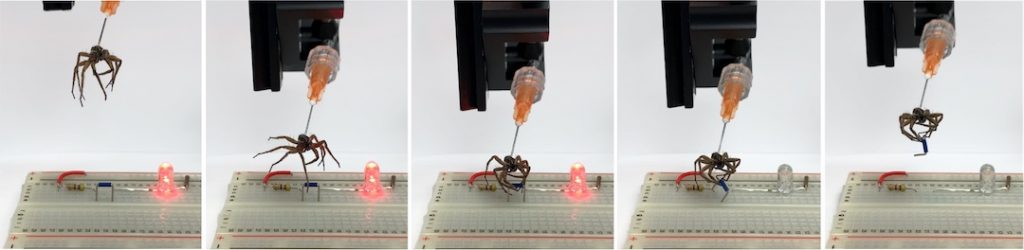
Among the tasks they set for their necrobotic spider, they had the grippers manipulate a circuit board, move objects and even lift another spider.
Preston sees that future applications could include microelectronic assembly.
“Another application could be deploying it to capture smaller insects in nature, because it’s inherently camouflaged,” Yap added.
This ability to capture an insect that’s the bodyweight (or even larger than) the necrobotic spider could come in handy, given that researchers will need to have a supply chain of dead spiders for their work.
The Show’s Going on – with Holographic Animals!
The use of wild animals has long been controversial, with many reports over the years of pretty horrifying cruelty. Under pressure from activists like PETA (People for the Ethical Treatment of Animals), in 2015 Ringling Brothers and Barnum & Bailey began phasing out the use of elephants. Pressure continued on them to stop using lions, tigers, and other wild animals as well. Ringling Brothers folded its tent in 2017, but it’s coming back next year. And when it does, “the greatest show on earth” will be animal-free.
The new show’s goal, [show producer] Feld [Entertainment] said, is to “celebrate amazing talent from around the world, displaying incredible feats that push the limits of human potential and create jaw-dropping moments.” (Source: NPR)
The absence of animal acts is probably a good thing. A number of states prohibit the use of wild or exotic animals in circuses. (The Big Apple Circus has always featured dogs, horses, and ponies instead. Cirque du Soleil has always been animal-free. The only animals are puppets.)
Several years ago, German-based Circus Roncalli is still featuring wild animals. Only the animals they’re using are 3-D holograms.
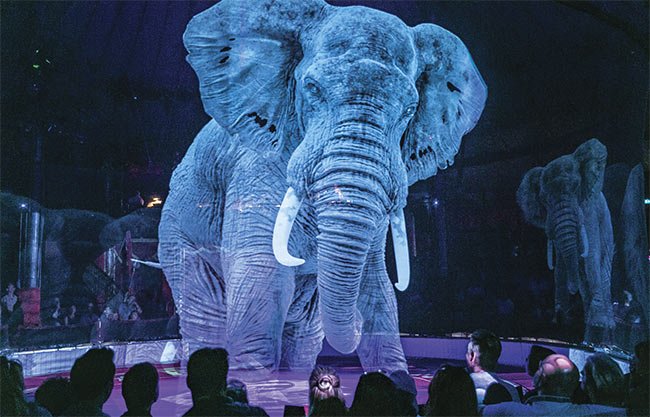
As German newspaper the Rheinische Post reports, Circus Roncalli was founded in 1976 and began phasing out animal performances in the 1990s. Since 2018, the show has featured no live animals, turning instead to holographic projections with 360-degree visibility for spectators seated around the ring. According to the BBC, it takes 11 projectors to pull off the feat.
Some of the holographic acts replicate traditional circus fare, like the performing elephant and an ethereal ring of horses that gallops around the big top. Other acts are more fantastical; circus-goers of the past, for instance, would not have been treated to the sight of a huge goldfish hovering in the middle of the ring. (Source: Smithsonian Magazine)
The use of holographic animals instead of the real thing brings with it a number of benefits. First and most obviously, it guarantees that no animals will be mistreated. But the holograms are also cheaper to maintain and transport.
Given the quality of the technology, and the fact that people have grown accustomed to – and expect – technology in all aspects of their life, I’m guessing that there are plenty of circus goers who prefer the experience. It’s still fascinating, but without the cruelty and the smells. Bonus that you can also see things like a giant goldfish, which is something that never could have happened in real life.
In case you’re wondering how the Circus Roncalli holograms work:
According to Dan Novy of MIT’s Media Lab, [Circus Roncalli’s founder and director, Bernhard] Paul’s animals are projections that rely on a material called scrims. Scrims create a floating 2D illusion via projectors and semitransparent, loose-weave material. The projections lack two distinguishing factors of true holograms: parallax and accommodation. While the light-based simulacrums capture the look of the animals, an accurate description lies in the uncanny valley between science and consumerism. Source: Photonics)
The Photonics article also gives a bit of a mini history on how holograms came about, going way back in time to Pythagoras, and ends on this note:
Daniel Smalley, a Brigham Young University professor of electrical and computer engineering who uses lasers to create 3D volumetric images, said it isn’t important whether the circus uses real holograms, projections, or even Pepper’s ghost, the optical illusion popularized by John Henry Pepper. The projected images are mesmerizing, and they are a move forward in the elimination of animal cruelty in circus acts.
I’ll bet those holographic animals are mesmerizing. Good to see that the show’s going on with them.
 Use our SOM Selector